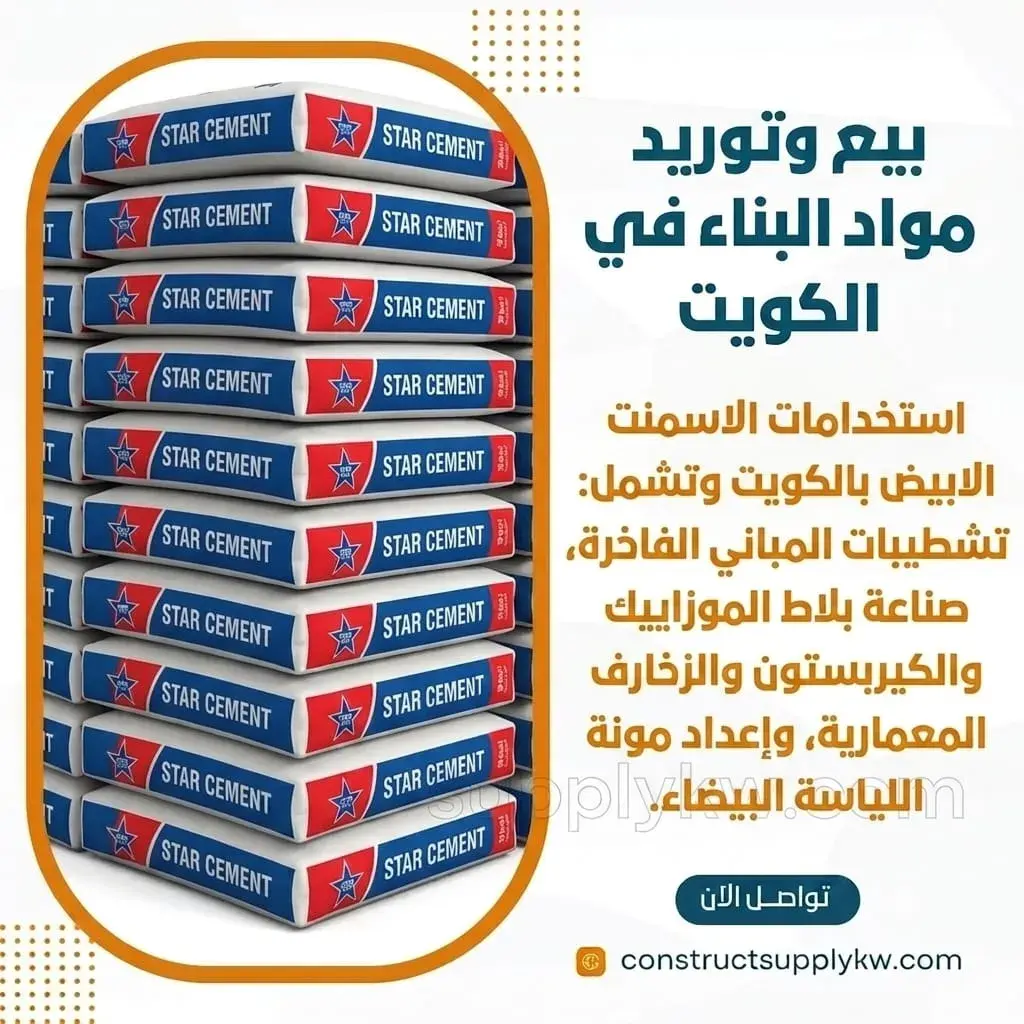
White Portland cement is one of the most advanced construction materials used in modern architectural finishing because it combines outstanding engineering performance with an elegant appearance that is difficult to achieve using conventional cement. As the use of white concrete and exposed architectural façades continues to expand across Kuwait, this type of cement has become a preferred choice among architects, designers, and premium finishing contractors—not simply because of its bright white color, but because of its physical and chemical properties that allow superior shaping, coloring, and the creation of decorative finishes that maintain their quality for many years. In this comprehensive guide, we explore the specifications of white Portland cement, its most important decorative applications, how to choose the right product, the most common mistakes to avoid, and the professional practices that have consistently delivered successful results in residential and commercial projects throughout Kuwait.
White Portland Cement
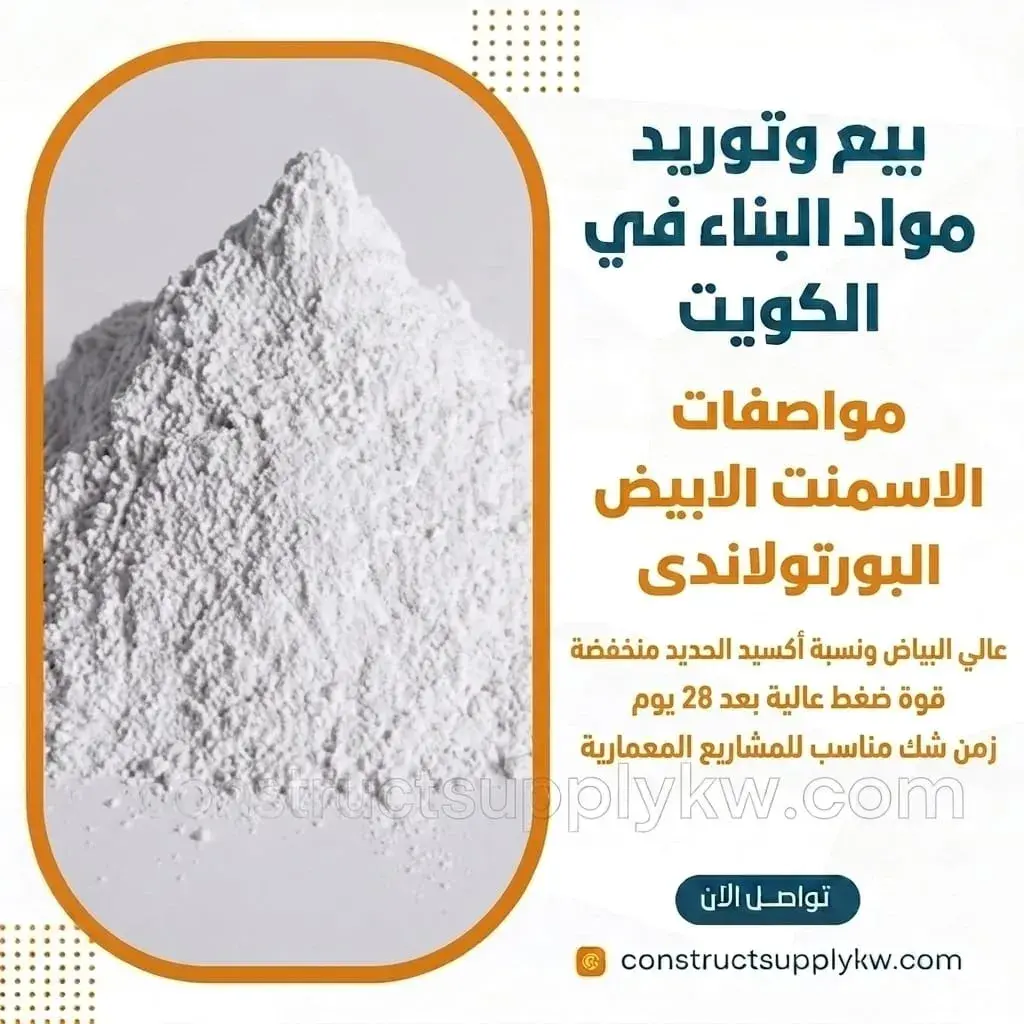
White Portland cement is a specialized type of Portland cement manufactured using carefully selected raw materials with extremely low levels of iron oxide and manganese oxide, the compounds primarily responsible for the gray color of conventional cement. This careful selection of raw materials produces a cement with exceptional whiteness while preserving the fundamental performance characteristics of Portland cement, including proper hydration, bonding strength, durability, and compatibility with aggregates and other construction materials. For this reason, white Portland cement should not be viewed merely as a decorative material but as an advanced engineering and architectural product capable of meeting the demands of modern construction and finishing projects.
In premium construction projects throughout Kuwait, white Portland cement has become an essential material for exposed architectural concrete, bright white façades, precast decorative components, and custom architectural features because it provides architects with remarkable design flexibility while maintaining consistent color and long-term visual stability. It is widely used in decorative concrete molds to manufacture architectural elements with exceptional dimensional accuracy and structural durability, reducing or even eliminating the need for additional finishing treatments after installation.
Field experience consistently demonstrates that the successful use of white Portland cement depends not only on selecting a high-quality product but also on proper storage, the cleanliness of all accompanying materials, accurate mixing proportions, well-manufactured molds, and appropriate curing methods after casting. When every one of these factors is executed according to professional standards, the final result is a smooth, bright white surface with outstanding architectural quality and excellent resistance to environmental conditions.
Continuous improvements in manufacturing technology over recent years have also enhanced color consistency while minimizing variations between production batches. This provides contractors, developers, and consultants with greater confidence when specifying white Portland cement for large-scale projects requiring visual uniformity across all exposed concrete components.
-
Manufactured from highly purified raw materials with minimal iron content.
-
Provides exceptional and consistent whiteness.
-
Combines engineering performance with architectural beauty.
-
Suitable for premium residential and commercial developments.
-
Ideal for exposed white concrete and decorative architectural elements.
-
Allows greater freedom for creating intricate architectural details.
-
Maintains color stability for many years when properly installed.
-
Requires suitable storage conditions to preserve its properties.
-
Successful performance depends equally on product quality and workmanship.
-
Considered one of the leading materials for contemporary architectural finishing.
White Portland Cement Specifications
The specifications of white Portland cement are defined by a comprehensive set of engineering standards that ensure reliable performance in both architectural and specialized construction applications. Many people mistakenly assume that whiteness alone determines product quality, but professional evaluation also includes compressive strength, setting time, dimensional stability, particle fineness, chemical composition, and compliance with recognized local and international standards. For this reason, reviewing the manufacturer's technical data sheet is an essential step before purchasing, particularly for projects that demand exceptional quality, long-term consistency, and premium architectural finishes.
Reputable manufacturers perform rigorous quality control testing on every production batch to verify that physical and chemical properties remain consistent. Even slight variations in raw materials or manufacturing conditions can influence color consistency, strength development, or workability. Products that comply with internationally recognized standards provide engineers and architects with greater confidence when specifying white concrete, exposed architectural finishes, or decorative structural elements that require predictable long-term performance.
For projects requiring exceptional precision—such as luxury villas, hotels, commercial complexes, museums, and landmark buildings—it is always recommended to select products backed by recognized quality certifications while also verifying production dates and storage conditions. Cement is highly sensitive to moisture and improper storage, meaning that even premium-quality material may experience reduced performance if handled incorrectly before use. Consequently, comparisons between competing products should always be based on technical specifications and laboratory performance rather than color alone or purchase price.
Practical construction experience consistently confirms that strict adherence to engineering specifications from the beginning of a project dramatically reduces the likelihood of defects during construction while ensuring uniform quality throughout every stage of execution. Selecting a technically certified product provides greater confidence, minimizes future maintenance requirements, and contributes to superior architectural results.
-
Exhibits a high degree of whiteness according to manufacturing standards.
-
Undergoes compressive strength and dimensional stability testing.
-
Features particle fineness suitable for precision finishing.
-
Provides setting characteristics that support professional installation.
-
Must comply with recognized engineering standards.
-
Consistent quality between production batches is essential.
-
Quality certifications increase product reliability.
-
Proper storage directly affects long-term performance.
-
Technical specifications are more important than price comparisons.
-
Selecting the correct product minimizes construction defects.
Cement for Exterior Facades
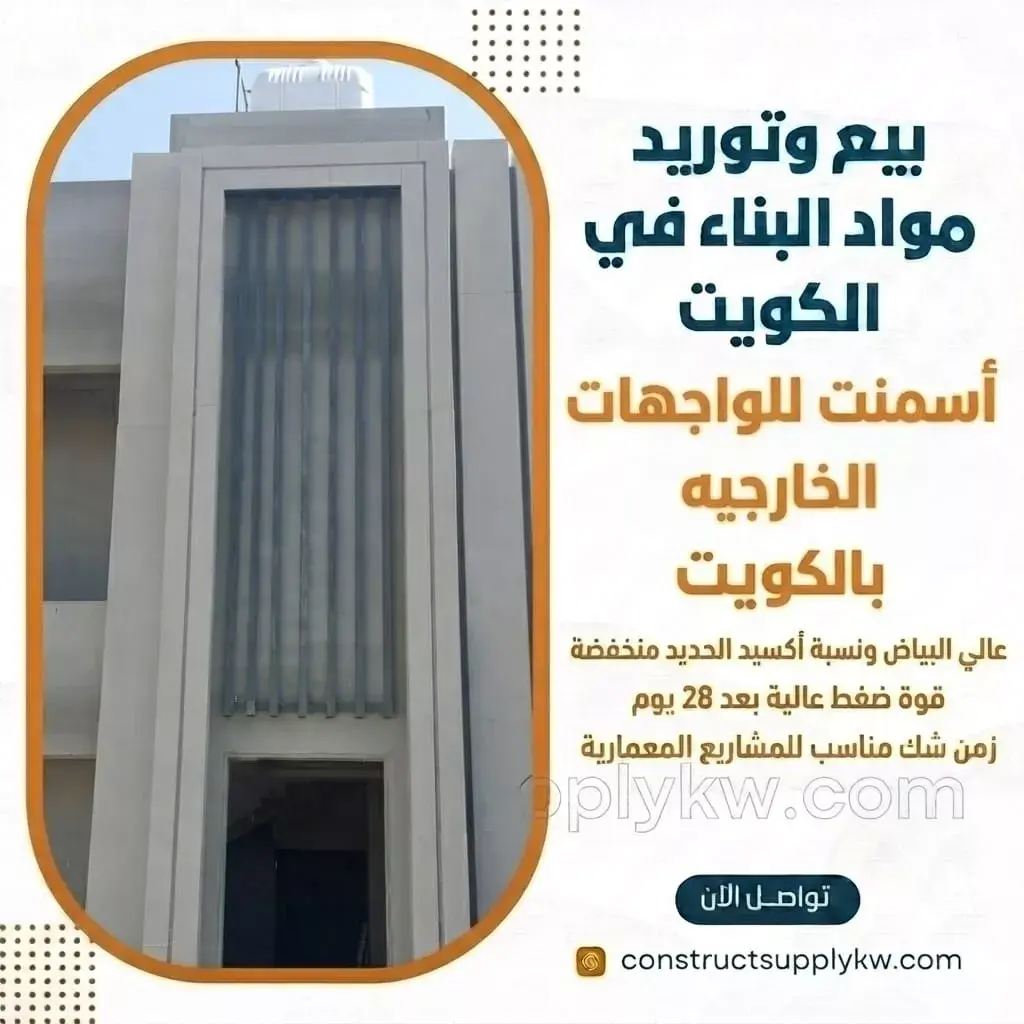
Using cement for exterior facades is one of the applications where the advantages of white Portland cement become most apparent because exterior surfaces must combine architectural elegance with long-term durability under demanding environmental conditions. Building facades are continuously exposed to sunlight, fluctuating temperatures, humidity, dust, and airborne contaminants. Selecting a material capable of maintaining both structural integrity and visual appeal under these conditions is therefore one of the most important decisions in architectural design.
Modern residential and commercial developments throughout Kuwait increasingly feature white architectural facades that define the identity of the building. White Portland cement enables architects to create clean, uniform surfaces that can remain exposed or be integrated with natural stone, glass, aluminum, and other premium materials to produce sophisticated contemporary designs. Its excellent workability also allows the production of cornices, frames, decorative bands, and architectural projections that enrich the appearance of the building without requiring additional finishing systems.
Field experience consistently demonstrates that the success of an exterior facade depends not only on selecting premium cement but also on designing a complete facade system that includes waterproofing, appropriate mixing proportions, professional application techniques, and proper curing after casting or plastering. Clean raw materials and uncontaminated water also play an essential role in maintaining color consistency while preventing stains or discoloration that may develop over time.
Professional contractors frequently prepare full-scale mock-ups before beginning large projects to verify color consistency, surface texture, and architectural appearance according to approved design requirements. Although this process requires additional preparation, it significantly reduces the possibility of visual inconsistencies that would be difficult and costly to correct after project completion.
-
Produces bright, uniform architectural facades.
-
Performs well under demanding environmental conditions when properly installed.
-
Ideal for modern residential and commercial buildings.
-
Integrates beautifully with stone, glass, and metal finishes.
-
Supports the creation of intricate architectural details.
-
Helps achieve low-maintenance exterior finishes.
-
Requires proper curing after installation.
-
Mock-up samples are recommended before full-scale construction.
-
Material quality significantly influences the final appearance.
-
A preferred solution for premium architectural facades.
Cement for Decorative Concrete Elements
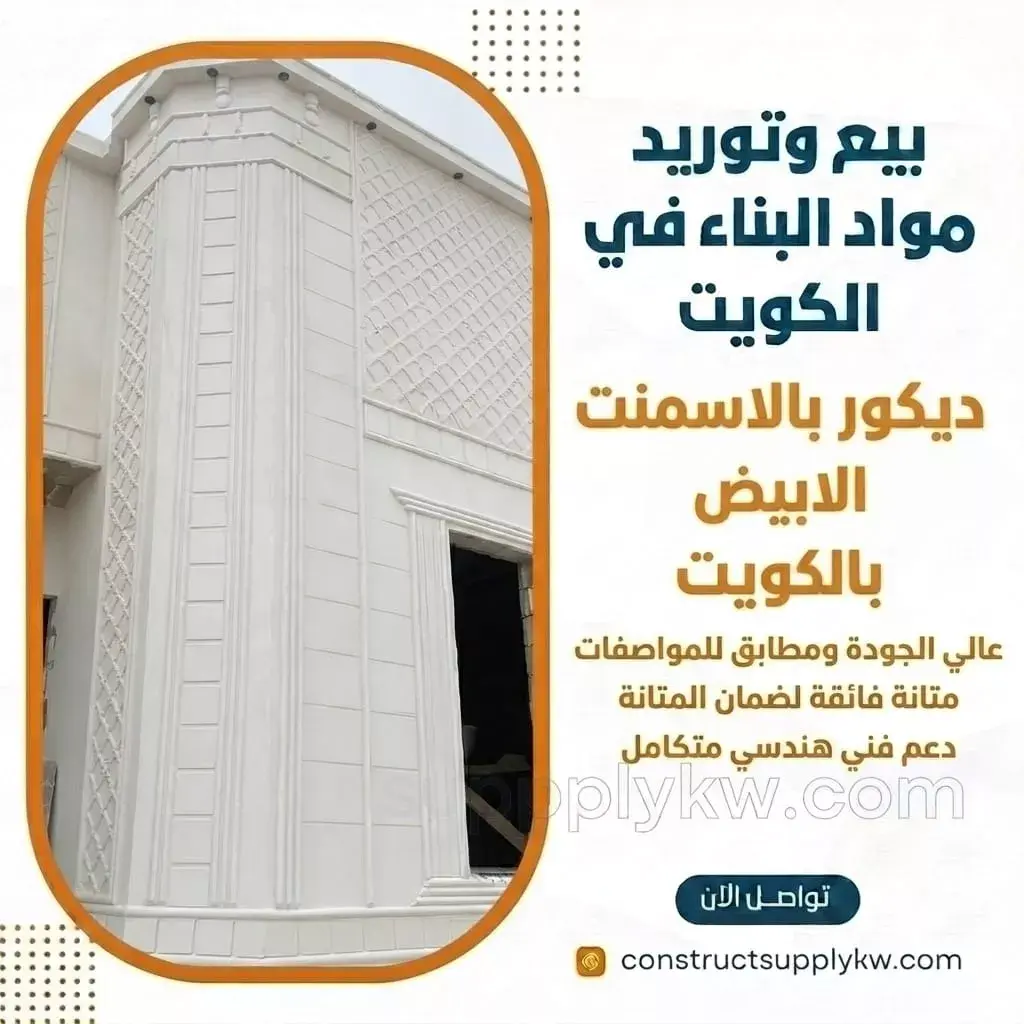
Cement for decorative concrete elements has become an essential component of modern architecture because designers no longer view concrete solely as a structural material. Instead, it has evolved into a design medium capable of producing artistic details that give buildings a unique architectural identity. White Portland cement is the preferred material for these applications because its bright white base highlights intricate mold details while creating decorative components with consistent color and refined surface quality, often eliminating the need for additional painting or finishing treatments.
Throughout residential and commercial developments in Kuwait, white Portland cement is widely used to manufacture decorative cornices, architectural frames, ornamental wall panels, decorative columns, balustrades, fountains, landscape planters, concrete seating, sculptures, and custom architectural features that depend on mold precision and superior surface finish. Its excellent molding characteristics enable manufacturers to create customized architectural components of varying sizes while preserving uniform color and exceptional detail, giving architects remarkable creative freedom in developing distinctive building designs.
Practical construction experience demonstrates that the success of decorative concrete depends on much more than cement quality alone. Professional mold fabrication, proper concrete vibration during casting, accurate mixing proportions, appropriate demolding times, and controlled curing all contribute to producing components free from voids, chipped edges, or inconsistent coloration. Carefully selected admixtures also improve workability, allowing the concrete to fill intricate mold details without compromising structural performance or long-term durability.
For this reason, experienced manufacturers almost always produce full-scale prototypes before beginning mass production. These trial pieces verify dimensional accuracy, color consistency, surface quality, and compliance with design expectations, especially for large architectural projects requiring hundreds of identical decorative components.
-
Ideal for producing decorative cornices and architectural ornaments.
-
Captures extremely fine mold details with exceptional clarity.
-
Creates decorative concrete elements with consistent white coloration.
-
Suitable for luxury residential and commercial developments.
-
Compatible with a wide variety of architectural mold designs.
-
Reduces the need for additional finishing treatments.
-
Requires proper curing after casting.
-
Final quality depends on both mold precision and workmanship.
-
Enables custom-made architectural components.
-
Combines long-term durability with sophisticated architectural beauty.
White Cement for Decorative Design
White cement for decorative design has become one of the defining materials of contemporary architecture, particularly as minimalist and natural-material design concepts continue to gain popularity. Today, white Portland cement is no longer limited to wall finishes or flooring. It is increasingly used to manufacture concrete tables, kitchen countertops, benches, shelves, sinks, three-dimensional feature walls, and even custom furniture pieces that create a distinctive balance between simplicity, elegance, and durability.
In Kuwait's architectural market, many interior designers and architects specify white Portland cement for projects that embrace modern aesthetics because it offers exceptional flexibility in shaping surfaces while blending beautifully with wood, natural stone, marble, glass, and metal. Its neutral white tone allows both natural and artificial lighting to highlight architectural details without overwhelming the overall design, making it an ideal material for residential villas, luxury retail spaces, hospitality venues, and contemporary office interiors.
Practical project experience has shown that successful decorative applications depend on careful planning rather than artistic creativity alone. Every decorative element requires proper consideration of thickness, reinforcement where necessary, support systems, casting methods, and installation techniques to achieve the intended appearance without compromising long-term durability. Selecting the correct white Portland cement for each decorative application also minimizes potential problems such as discoloration, weakened edges, shrinkage cracks, or surface imperfections caused by inappropriate material selection.
Field experience consistently confirms that decorative white cement is not simply a temporary design trend. Instead, it has become a long-term architectural solution because of its durability, low maintenance requirements, and ability to integrate seamlessly into both modern and traditional architectural styles while maintaining its visual appeal for many years.
-
Ideal for modern minimalist architectural designs.
-
Used to manufacture furniture and decorative architectural components.
-
Combines naturally with wood, glass, marble, and metal finishes.
-
Creates elegant contemporary architectural environments.
-
Supports complex geometric and custom-made designs.
-
Enables personalized architectural solutions.
-
Certain decorative components require structural engineering consideration.
-
Maintains its appearance for many years with proper installation.
-
Reduces dependence on additional decorative finishing materials.
-
Frequently specified for premium architectural developments.
White Concrete
White concrete represents one of the most advanced applications of white Portland cement because it successfully combines structural performance with architectural beauty in a single material. Unlike conventional gray concrete, which is often covered by paint, stone, or other finishing materials, white concrete is intentionally left exposed to become a permanent architectural feature. For this reason, it is widely used in museums, cultural centers, luxury villas, commercial buildings, civic structures, and landmark architectural projects where aesthetics are as important as structural integrity.
Producing high-quality white concrete begins with the careful selection of every component in the mix. Success depends not only on using premium white Portland cement but also on selecting light-colored aggregates, clean washed sand, uncontaminated water, and compatible chemical admixtures. Formwork must also be perfectly clean because even minor contamination can affect the final appearance. During placement, the concrete must be evenly distributed and properly vibrated to eliminate air voids while producing a dense, smooth, and visually consistent surface.
Construction experience throughout Kuwait has shown that white concrete requires a higher level of quality control than conventional concrete because even slight variations in mixing proportions, material quality, or construction methods may produce noticeable differences in color or undesirable formwork marks. Professional contractors therefore rely on carefully tested mix designs and produce mock-up samples before beginning major construction to verify that the final appearance matches the approved architectural concept.
White concrete also offers significant long-term architectural and economic benefits because it often eliminates the need for paint, cladding, or decorative coatings while giving buildings a timeless contemporary appearance that remains attractive for decades when executed according to recognized engineering standards.
-
Widely used in modern architectural construction.
-
Combines structural performance with architectural elegance.
-
Requires premium-quality raw materials throughout the mix.
-
Every ingredient must remain clean and uncontaminated.
-
Careful execution is essential for maintaining color consistency.
-
Often eliminates the need for additional finishing systems.
-
Suitable for distinctive residential and commercial developments.
-
Benefits from precision-engineered formwork.
-
Mock-up samples are recommended before full-scale construction.
-
Creates architectural surfaces that remain attractive for decades.
Coloring White Cement
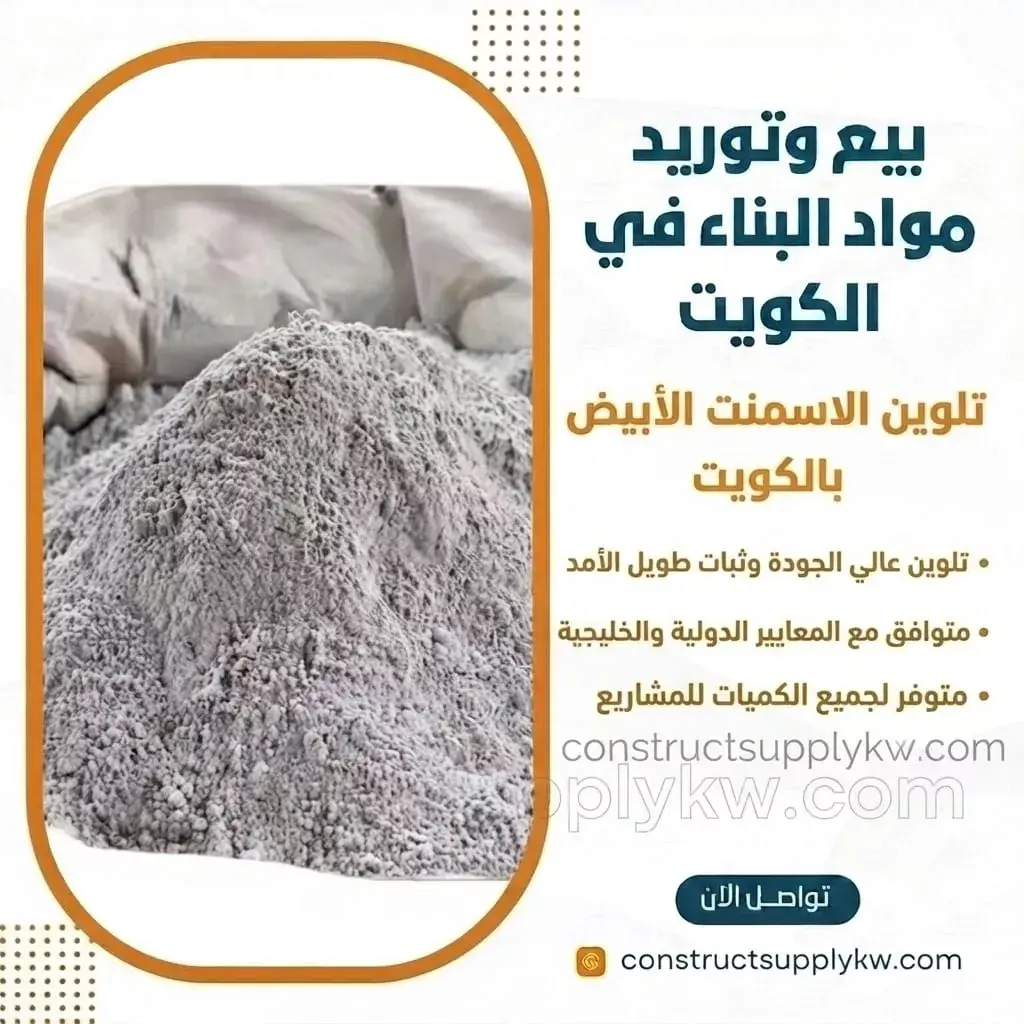
Coloring white cement is one of the greatest advantages of white Portland cement because its naturally bright color provides an ideal base for producing vivid, accurate, and consistent architectural colors. Unlike gray cement, which can dull or distort pigments, white cement allows mineral pigments to display their true intensity and clarity. This capability enables architects and designers to create an extensive range of colored decorative finishes for facades, pavements, architectural elements, exposed concrete, and landscape features while maintaining exceptional long-term color stability.
In contemporary projects throughout Kuwait, mineral oxide pigments are frequently combined with white Portland cement to produce distinctive architectural facades, decorative walkways, landscape planters, outdoor seating, and customized design elements that reinforce the architectural identity of each project. However, successful coloring requires much more than simply adding pigment. Contractors must carefully follow manufacturer-recommended dosage rates while selecting premium-quality pigments capable of resisting ultraviolet radiation and harsh environmental conditions to ensure lasting color stability.
Maintaining identical mixing proportions throughout every production batch is equally important because even minor variations in cement content, water quantity, or pigment dosage may produce noticeable differences between adjacent architectural elements. Professional contractors therefore use precision measuring equipment and maintain detailed production records for every batch, particularly on large-scale developments where absolute visual consistency is essential.
Field experience consistently demonstrates that the most durable coloring results are achieved when pigments become an integral part of the concrete mixture rather than being applied as a surface coating. Integrally colored concrete maintains its appearance even after years of wear and weather exposure, providing a significantly longer architectural lifespan than conventional painted finishes.
-
Provides an ideal white base for vibrant architectural colors.
-
Readily accepts premium mineral oxide pigments.
-
Produces long-lasting colored decorative finishes.
-
Suitable for facades, pavements, and decorative concrete.
-
Requires accurate pigment proportions for color consistency.
-
UV-resistant pigments improve long-term durability.
-
Consistent mixing prevents color variation.
-
Integral coloring outperforms surface-applied coatings.
-
Professional workmanship ensures complete color uniformity.
-
Offers architects exceptional creative design flexibility.
Cementitious Facade Finishing
Cementitious facade finishing is the stage where raw construction materials are transformed into architectural surfaces that define a building's identity and overall quality. Using white Portland cement during this phase provides both outstanding visual appeal and long-term performance. Beyond its naturally bright white color, this cement allows architects and contractors to create smooth finishes, textured finishes, exposed concrete appearances, or custom architectural surface treatments that complement modern, classical, and industrial architectural styles alike.
Achieving a high-quality cementitious facade begins with proper substrate preparation. The base surface must be level, structurally sound, and free from contaminants before any finishing material is applied. The mortar mix should then be carefully designed according to project requirements, local climate conditions, and the desired architectural finish. Kuwait's hot climate presents additional challenges, making proper scheduling particularly important. Experienced contractors frequently perform exterior finishing during cooler periods of the day or provide temporary shading to reduce rapid moisture evaporation that could negatively affect the finished surface.
Practical field experience consistently demonstrates that curing after application is just as important as the finishing process itself. Maintaining sufficient moisture during the early curing period allows cement hydration to continue properly, reducing shrinkage while improving both durability and surface quality. Professional inspections before project handover also allow contractors to identify minor differences in texture or color and correct them before they become permanent architectural defects.
When every stage is executed according to recognized engineering practices, cementitious facades become durable architectural elements that combine elegant appearance with low maintenance requirements and excellent long-term performance. This is one of the primary reasons why white Portland cement continues to be specified for premium residential, commercial, and institutional projects.
-
Produces elegant architectural facade finishes.
-
Supports smooth, textured, and custom surface treatments.
-
Requires careful substrate preparation before installation.
-
Weather conditions influence finishing quality.
-
Proper curing significantly improves long-term performance.
-
Final inspections ensure color and texture consistency.
-
Suitable for residential and commercial buildings.
-
Reduces long-term maintenance requirements.
-
Maintains its architectural appearance for many years.
-
Enhances the visual value of the entire building.
White Cement Strength
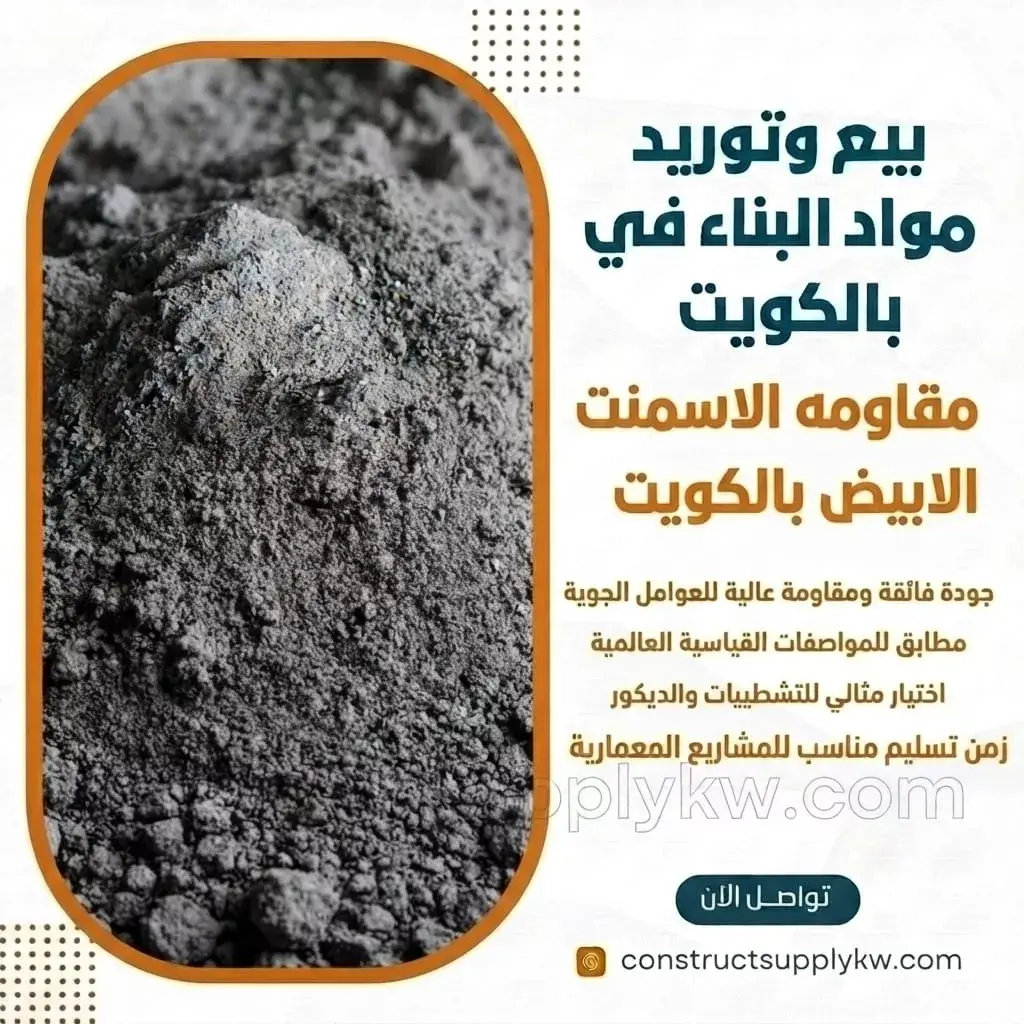
White cement strength is one of the most important characteristics that determine whether the material is suitable for a particular architectural or construction application. Strength should not be understood solely as compressive strength. It also includes durability against environmental exposure, color stability, surface wear resistance, dimensional stability, and the ability to maintain mechanical performance throughout the service life of the structure. Consequently, evaluating white Portland cement requires a comprehensive engineering assessment rather than focusing on a single laboratory value.
The final strength achieved by white cement depends upon an integrated system of factors beginning with the purity of raw materials, manufacturing quality, storage conditions, accurate proportioning, mixing procedures, placement methods, and curing practices. Even premium white Portland cement cannot perform as intended if combined with poor-quality aggregates, contaminated water, or incorrect installation techniques. Engineers therefore emphasize that material quality and construction quality are inseparable when pursuing long-term project performance.
Construction projects throughout Kuwait present additional challenges because cementitious materials must withstand high ambient temperatures, prolonged solar exposure, and, in some coastal areas, fluctuating humidity levels. Selecting products that comply with internationally recognized standards while following professional installation procedures enables white Portland cement to maintain both its structural performance and architectural appearance for many years with minimal maintenance.
Regular quality control testing throughout construction—including material inspections, laboratory testing, mix verification, and sample evaluations—provides project owners, consultants, and contractors with greater confidence in the completed work. These procedures also reduce the likelihood of future performance problems while ensuring that the finished project satisfies both engineering and architectural expectations.
-
Provides reliable performance when engineering standards are followed.
-
Strength includes both mechanical and environmental performance.
-
Professional workmanship directly affects long-term durability.
-
High-purity raw materials improve overall performance.
-
Proper storage preserves engineering properties.
-
Environmental conditions influence service life.
-
Routine quality testing increases construction reliability.
-
Correct curing enhances long-term durability.
-
Compliance with engineering specifications minimizes future failures.
-
Comprehensive quality control delivers superior project performance.
Advantages of White Portland Cement
The advantages of white Portland cement extend far beyond its attractive white appearance, making it one of the most valuable materials available for projects that combine architectural excellence with engineering performance. It provides exceptional design flexibility, excellent moldability, consistent color, and the ability to manufacture decorative concrete products with outstanding dimensional accuracy and refined surface finishes. As a result, it has become the preferred material for luxury facades, decorative concrete components, exposed architectural concrete, and premium construction projects where visual quality is equally as important as structural integrity.
One of its greatest advantages is that the white color becomes an integral part of the material itself rather than being applied as paint or another surface treatment. This significantly reduces long-term maintenance requirements while preserving the building's appearance for many years. White Portland cement also integrates exceptionally well with natural stone, marble, wood, glass, aluminum, and steel, allowing architects to develop distinctive architectural concepts that combine multiple materials without sacrificing visual harmony.
Field experience consistently demonstrates that investing in premium-quality white Portland cement delivers substantial long-term value. Stable color, durable surfaces, minimal maintenance, superior finish quality, and long service life all contribute to increasing the overall value of the completed project while reducing future repair and renovation costs. These benefits explain why leading architectural firms, developers, and construction consultants continue to specify white Portland cement for projects where exceptional quality and architectural distinction are priorities.
Its versatility also allows designers to move beyond traditional finishing methods by creating exposed concrete architecture, sculptural elements, custom landscape features, decorative walls, and innovative building details that remain attractive for decades. When combined with proper engineering design and professional workmanship, white Portland cement offers an unmatched combination of beauty, durability, and long-term value.
-
Produces a naturally bright and consistent white appearance.
-
Offers exceptional flexibility for architectural design.
-
Ideal for white concrete and decorative concrete applications.
-
Reduces dependence on paint and additional cladding systems.
-
Integrates beautifully with a wide range of finishing materials.
-
Provides excellent moldability for complex architectural details.
-
Maintains its appearance for many years.
-
Increases the architectural value of completed projects.
-
Reduces future maintenance and renovation costs.
-
Combines outstanding engineering performance with premium aesthetics.
Conclusion
White Portland cement is far more than a material that simply gives concrete a white appearance. It is a comprehensive architectural and engineering solution that enables designers, engineers, and contractors to produce projects that would be difficult to achieve using conventional gray cement. From exposed white concrete and decorative architectural elements to luxury facades and premium finishes, white Portland cement delivers exceptional visual quality while maintaining the mechanical performance expected from high-grade Portland cement. Its growing popularity in Kuwait reflects the increasing demand for modern architectural materials that combine durability, elegance, and long-term value.
As demonstrated throughout this guide, outstanding results depend on much more than selecting a premium product. Proper material selection, accurate mixing proportions, clean raw materials, professional workmanship, high-quality molds, and correct curing procedures all work together to determine the final outcome. Practical experience from numerous construction projects throughout Kuwait has consistently shown that attention to these details produces architectural concrete and decorative finishes that maintain their beauty and structural integrity for many years, whereas seemingly minor installation errors may lead to color inconsistency, surface defects, or reduced durability regardless of the quality of the cement itself.
For this reason, the best investment in decorative concrete and architectural facade projects is not simply purchasing the least expensive product, but selecting a white Portland cement that complies with internationally recognized standards, obtaining it from a trusted supplier, and ensuring installation is carried out by experienced professionals familiar with this specialized material. When premium materials are combined with expert craftsmanship, the result is elegant architectural facades, precisely manufactured decorative components, and durable finishes that continue to enhance the appearance and value of the project for decades with minimal maintenance.
Frequently Asked Questions
What is white Portland cement?
White Portland cement is a specialized type of Portland cement manufactured from carefully selected raw materials containing very low levels of iron and manganese oxides. This process produces a bright white cement while maintaining the fundamental engineering properties of conventional Portland cement, making it suitable for architectural, decorative, and selected structural applications.
What is the difference between white Portland cement and gray Portland cement?
The primary difference lies in the raw materials and manufacturing process. White Portland cement is produced from highly purified materials that create a bright white appearance, while gray Portland cement is intended primarily for general construction applications and does not provide the same architectural finish for exposed surfaces.
Can white Portland cement be used for exterior facades?
Yes. White Portland cement is considered one of the best materials for architectural facades when installed according to proper engineering practices. It provides a uniform white appearance, supports intricate architectural detailing, and maintains its visual quality for many years with appropriate curing and maintenance.
Is white Portland cement suitable for decorative concrete elements?
Absolutely. It is widely used to manufacture cornices, decorative columns, architectural moldings, ornamental panels, precast decorative elements, and custom concrete products because of its excellent fineness, dimensional accuracy, and ability to reproduce intricate mold details.
Can white Portland cement be colored?
Yes. White Portland cement provides the ideal base for mineral oxide pigments because its bright color allows pigments to produce cleaner, richer, and more consistent colors than gray cement. Proper pigment proportions and professional mixing practices are essential for achieving uniform architectural finishes.
Does white concrete require different materials than conventional concrete?
Yes. High-quality white concrete requires white Portland cement, light-colored aggregates, clean washed sand, uncontaminated water, compatible admixtures, clean formwork, and carefully controlled construction techniques to achieve consistent color and premium architectural quality.
How can I preserve the white appearance after construction?
Maintaining the bright white appearance requires clean raw materials, accurate mixing proportions, contamination-free equipment, proper curing, and careful workmanship throughout construction. Preventing contamination from gray cement or construction debris is equally important for preserving color consistency.
What are the main advantages of white Portland cement?
Its most significant advantages include its naturally bright white appearance, excellent workability, compatibility with architectural coloring, outstanding finishing quality, suitability for exposed white concrete and decorative applications, long-term durability, color stability, and the ability to create premium architectural projects that require minimal maintenance over their service life.