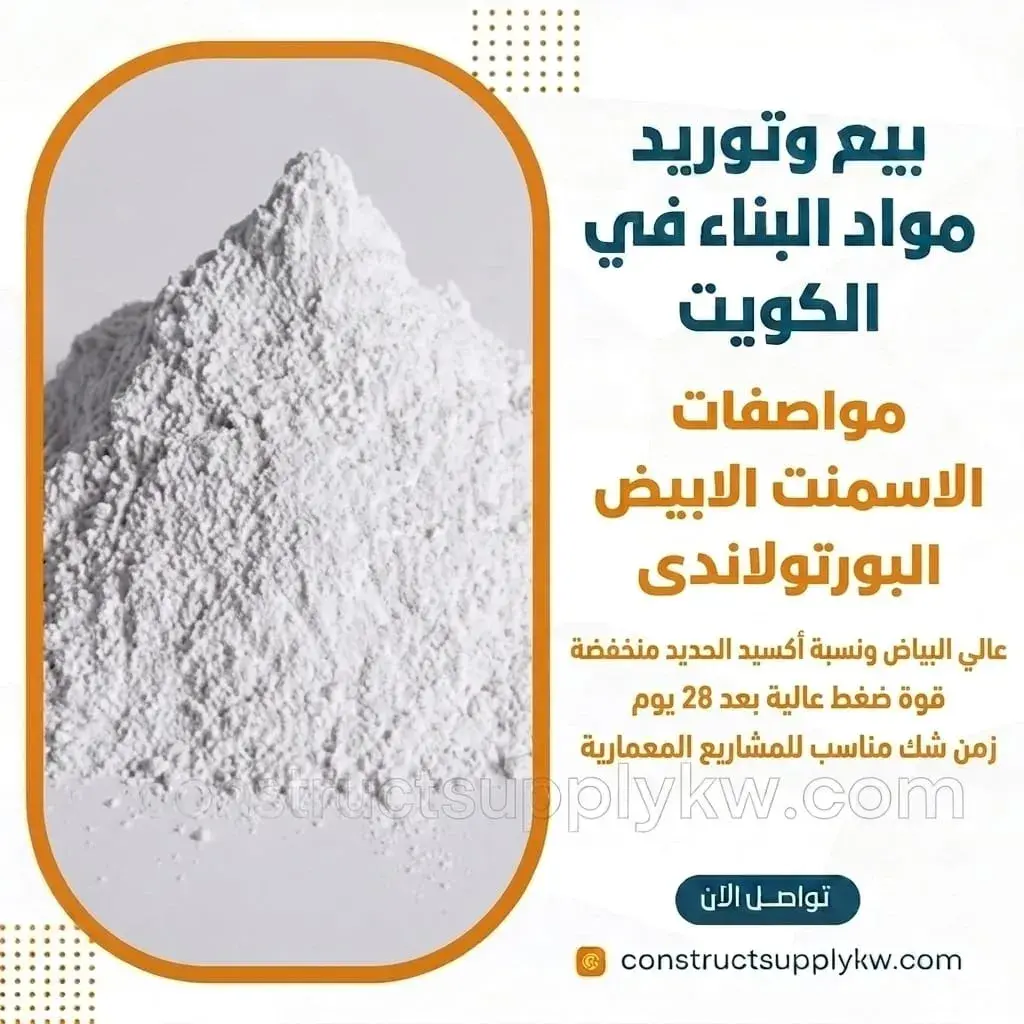
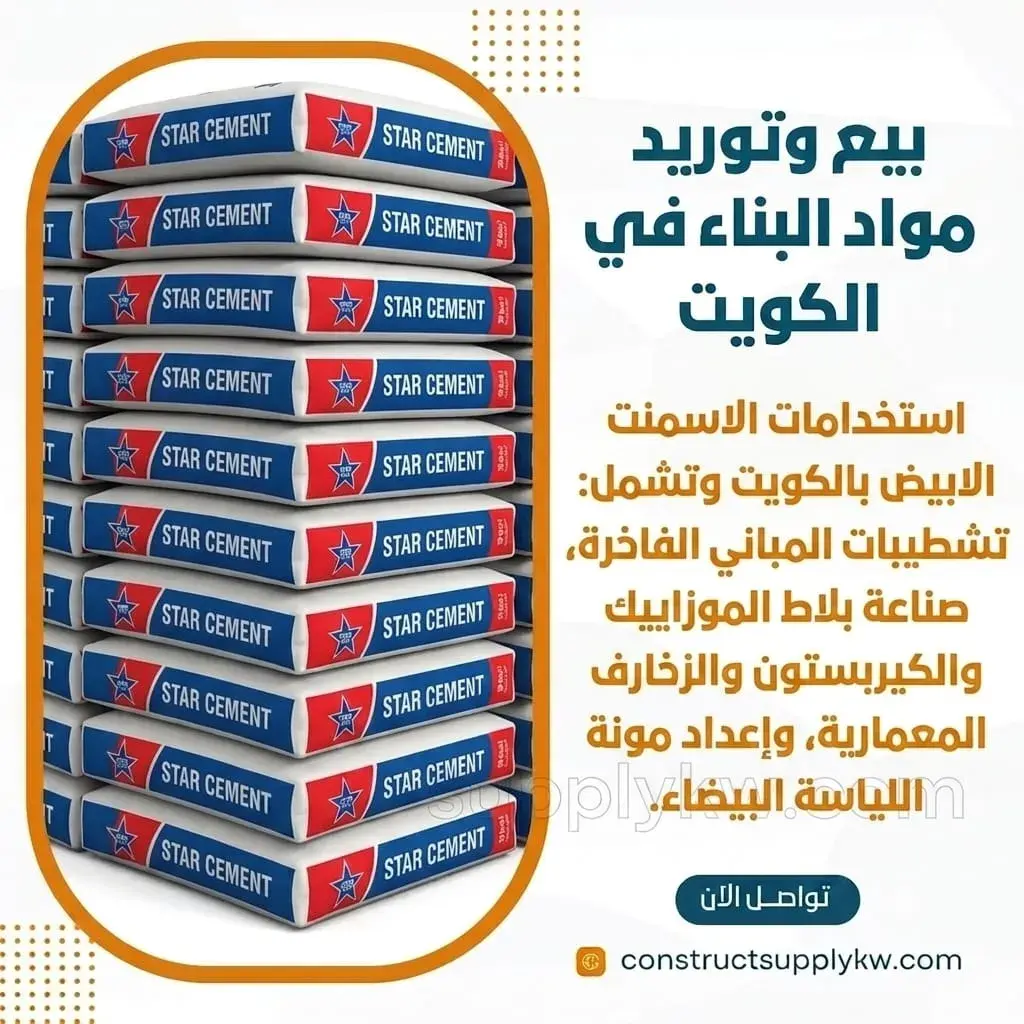
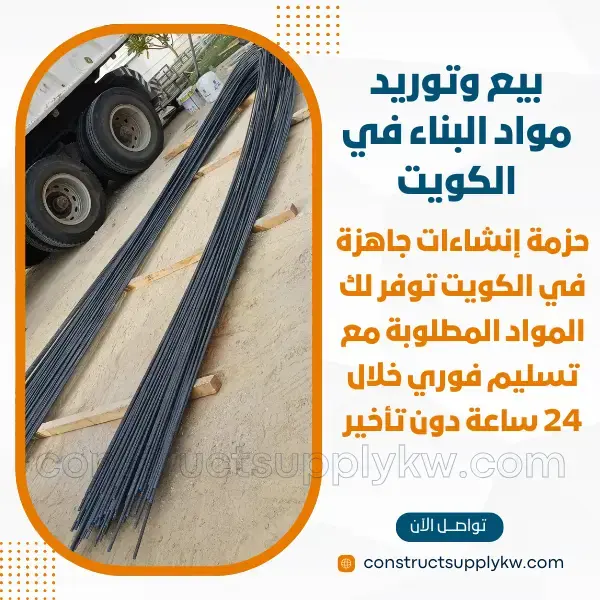
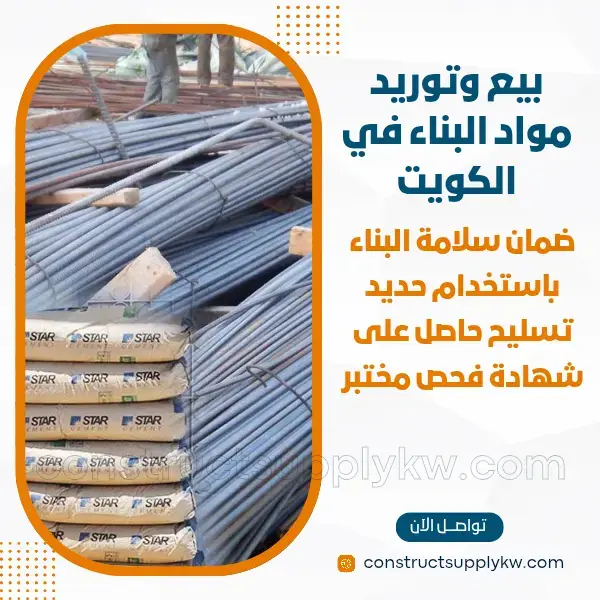
Kuwait's coastal environment presents engineering challenges that differ significantly from many other regions. High salt concentrations, continuous humidity, saline groundwater, and air saturated with sea spray all accelerate concrete deterioration if suitable construction materials are not selected from the beginning of the project. For this reason, sulfate-resistant white cement has become an important choice for projects that combine architectural aesthetics with long-term structural protection. It provides the distinctive white appearance required for premium architectural finishes while offering enhanced resistance to sulfate attack and chemical deterioration caused by aggressive coastal conditions. In this comprehensive guide, we examine the characteristics of sulfate-resistant white cement, the correct methods for using it, its most important applications in Kuwait's coastal areas, and the common mistakes that reduce concrete performance even when high-quality materials are specified.
Sulfate-Resistant White Cement
Sulfate-resistant white cement is a specialized construction material developed to meet the requirements of projects exposed to environments containing high sulfate concentrations, whether in soil, groundwater, or marine conditions. This type differs from conventional white cement through the composition of its clinker and the controlled proportion of specific chemical compounds, particularly tricalcium aluminate, whose content is reduced to minimize harmful reactions with sulfates. As a result, the cement helps reduce internal expansion and cracking that may develop over time due to destructive chemical reactions while maintaining the elegant white appearance required for architectural applications.
In Kuwait's coastal construction projects, this specialized cement is increasingly specified for waterfront buildings, recreational facilities, seawalls, and exposed architectural concrete elements that require both visual appeal and long-term durability. Engineers frequently recommend it for projects where architectural appearance plays a significant role because sulfate-resistant white cement successfully combines two important objectives: preserving an attractive white finish while improving the concrete's ability to withstand aggressive environmental exposure.
Practical field experience consistently demonstrates that selecting sulfate-resistant cement alone is not sufficient to achieve a long service life. High-quality aggregates, properly controlled water-to-cement ratios, dense concrete, and correct curing procedures after placement are equally essential. When all of these elements are combined correctly, sulfate penetration into the concrete is significantly reduced, and the structure becomes more capable of resisting deterioration in aggressive environments.
Many consultants also emphasize reviewing compliance certificates and technical specifications before purchasing any product because sulfate resistance is an engineering property that must be verified through standardized laboratory testing rather than relying solely on marketing claims printed on product packaging.
-
Specifically designed to resist sulfate attack in aggressive environments.
-
Combines architectural whiteness with long-term durability.
-
Suitable for coastal developments and marine-adjacent structures.
-
Helps reduce internal expansion caused by chemical reactions.
-
Preserves architectural appearance while improving structural performance.
-
Delivers the best results when used in properly designed concrete mixes.
-
Performs most effectively with high-quality, low-absorption aggregates.
-
Engineering performance depends on compliance with technical specifications.
-
Should be obtained from reputable manufacturers supported by certified testing.
-
Represents a long-term investment in projects exposed to salts and sulfates.
Salt-Resistant Cement
Many project owners search for salt-resistant cement, believing that all cement products perform equally in saline environments. In reality, engineering performance varies considerably because dissolved salts found in soil, groundwater, and sea spray interact with concrete in different ways and may gradually weaken its internal structure if the concrete mixture is not properly designed. Consequently, selecting the appropriate cement should be viewed as the first step within a comprehensive protection system rather than as a complete solution by itself.
Throughout Kuwait, many residential and commercial developments are exposed to elevated salt concentrations, particularly in coastal districts. Engineers therefore prioritize construction materials that reduce concrete permeability and limit the migration of salts into the structure. Sulfate-resistant white cement is an excellent option whenever projects also require premium white architectural finishes because it helps reduce certain chemically aggressive effects associated with saline environments, provided that the concrete mixture, construction methods, and curing practices all comply with engineering standards.
Experience gained from numerous construction projects has shown that resistance to salts depends not only on the cement itself but also on the water-to-cement ratio, proper vibration during placement, adequate concrete cover over reinforcing steel, and correct curing procedures. Dense concrete absorbs significantly less moisture and fewer dissolved salts than porous concrete. For this reason, construction quality often has a greater influence on long-term durability than the cement type alone.
A common misconception is that white concrete is inherently less durable than gray concrete. In reality, long-term performance depends on the complete concrete system, not on the color of the cement used during construction.
-
Helps reduce the effects of salts when incorporated into a properly designed concrete mix.
-
Slows the migration of salts through dense concrete.
-
Suitable for saline soil conditions.
-
Requires low-permeability concrete for optimal performance.
-
Construction quality directly influences protection levels.
-
Proper curing significantly improves durability.
-
Adequate concrete cover protects reinforcing steel.
-
Engineering performance is independent of cement color.
-
Compliance with structural specifications remains essential.
-
Produces the best results when integrated into a complete protection strategy.
Cement for Coastal Areas
Selecting cement for coastal areas requires careful evaluation of environmental conditions rather than focusing only on product cost or brand recognition. Buildings located near the sea are continuously exposed to humidity, airborne salts, sea spray, and temperature fluctuations, all of which affect concrete throughout its service life. Consequently, selecting suitable cement during the design stage is not merely an engineering decision but also an economic one because it significantly reduces future maintenance and repair costs.
Practical experience from Kuwait's coastal developments demonstrates that structures built using materials specifically designed for marine environments consistently outperform projects relying on conventional cement without considering environmental exposure. Sulfate-resistant white cement also enables the construction of exposed white concrete facades and architectural features that combine elegant appearance with improved environmental durability. This makes it particularly suitable for villas, resorts, waterfront buildings, and public facilities where both aesthetics and durability are critical design objectives.
Another important consideration is that the long-term success of coastal construction depends upon much more than cement selection. Engineers also specify corrosion-resistant reinforcement systems where necessary, supplementary materials to reduce permeability when appropriate, drainage systems that prevent standing water, and strict quality control throughout every stage of construction. The more effectively these elements are integrated, the greater the structure's ability to withstand harsh marine conditions while maintaining its appearance and performance over many decades.
For this reason, engineers consistently advise clients not to base cement selection solely on purchase price. A relatively small difference in material cost can prevent substantial future expenditures associated with repairs, rehabilitation, and premature deterioration caused by aggressive coastal environments.
Cement for Marine Environments
Selecting cement for marine environments differs significantly from choosing cement for inland projects because marine structures are continuously exposed to salts, humidity, chlorides, sulfates, fluctuating temperatures, wave action, and sea spray. These aggressive conditions affect not only the exterior surface of concrete but can gradually penetrate into its internal structure if permeability is high or if the concrete mixture and curing procedures are not properly executed. For this reason, sulfate-resistant white cement is an excellent choice for projects requiring bright architectural finishes while providing improved resistance to sulfate-related chemical attack in harsh marine conditions.
In projects located near Kuwait's coastline, this type of cement is widely used in exposed architectural facades, decorative concrete elements, perimeter walls, walkways, service buildings, and landscape structures that require both long-term durability and an elegant white appearance. However, it is important to distinguish between sulfate resistance and chloride resistance. Sulfate-resistant cement reduces the harmful effects of sulfate attack, but by itself it does not completely prevent chloride ions from reaching reinforcing steel. Consequently, engineers must also specify low-permeability concrete, carefully controlled water-to-cement ratios, sufficient concrete cover, proper consolidation, effective curing, and, where required, supplementary cementitious materials or protective systems based on soil investigations and environmental exposure classifications.
Practical construction experience consistently shows that successful marine construction begins with understanding site conditions rather than simply selecting an expensive cement product. A structure built directly on the shoreline faces different environmental demands than one located several kilometers inland, while buried foundations in saline soil require different protection measures than elevated architectural facades exposed mainly to airborne sea spray. Engineers therefore evaluate the exposure category before approving the cement type, concrete mixture, reinforcement protection, and construction methodology because long-term durability results from a complete engineering system rather than from cement selection alone.
-
Suitable for white architectural elements exposed to marine humidity and salts when incorporated into a properly engineered concrete system.
-
Requires evaluation of marine exposure conditions before selecting cement and concrete proportions.
-
Sulfate resistance should not be considered a complete substitute for chloride protection measures.
-
Dense, low-permeability concrete significantly slows the movement of aggressive substances.
-
Reinforcing steel requires concrete cover that complies with engineering standards.
-
Different marine structures require different levels of protection depending on exposure conditions.
-
Laboratory testing and trial concrete mixes help verify material suitability before construction.
-
Proper drainage reduces prolonged moisture accumulation around coastal concrete.
-
Highly aggressive environments may require additional protective coatings or corrosion protection systems.
-
Correct engineering decisions balance architectural appearance with long-term structural performance.
Sulfate Resistance in Concrete
.webp)
Sulfate resistance in concrete is achieved when the concrete system is specifically designed to limit sulfate penetration and reduce the chemical reactions that may otherwise lead to internal expansion, cracking, and gradual deterioration. Sulfates naturally occur in certain soils, groundwater, industrial environments, and coastal regions. When these sulfate compounds penetrate concrete, they may react with particular cement hydration products, producing expansive compounds that create internal pressure. Over time, these reactions can initiate cracking, surface deterioration, and a progressive reduction in structural durability if appropriate preventive measures are not incorporated during design and construction.
Sulfate-resistant white cement plays an important role by reducing the availability of cement compounds that are most susceptible to sulfate attack. Nevertheless, it remains only one component of an integrated durability strategy. Concrete with excessive permeability allows aggressive solutions to penetrate regardless of the cement selected, whereas dense concrete with carefully controlled water content, proper consolidation, and effective curing substantially slows deterioration. Engineers must also evaluate sulfate concentration, groundwater conditions, exposure cycles, temperature variations, and moisture fluctuations because each of these factors influences both the severity of sulfate attack and the appropriate engineering solution.
Professional engineering practice begins with laboratory analysis of soil and groundwater before construction starts. These investigations determine sulfate concentration and help engineers select the appropriate cement type, water-to-cement ratio, concrete cover, and mixture design according to applicable engineering standards. Some projects may also require supplementary cementitious materials that improve concrete density while remaining compatible with the required white architectural finish. Consequently, product selection should always rely on verified laboratory data and certified technical documentation rather than marketing descriptions alone.
One of the most common construction mistakes is adding excessive water to improve workability at the job site. Although this makes concrete easier to place, it substantially increases permeability and reduces actual sulfate resistance. A properly designed concrete mix with suitable admixtures provides much better workability without sacrificing long-term durability.
-
Sulfate resistance begins with proper soil and groundwater investigation.
-
Specialized cement reduces harmful chemical reactions when used according to engineering specifications.
-
Low-permeability concrete significantly limits sulfate penetration.
-
Excessive mixing water greatly reduces long-term durability.
-
Proper curing produces a denser and more durable concrete structure.
-
Sulfate attack varies according to environmental concentration and exposure conditions.
-
Concrete mixtures should be approved through laboratory testing rather than marketing claims.
-
Construction joints and penetrations require careful detailing because they may become vulnerable locations.
-
Quality control during placement prevents honeycombing and excessive permeability.
-
Long-term durability depends on integrating design, materials, construction, and inspection.
Protecting Concrete from Corrosion
Protecting concrete from corrosion begins long before rust or visible cracking appears because corrosion is a gradual process rather than a sudden structural failure. Normally, concrete provides an alkaline environment that naturally protects reinforcing steel by forming a passive protective layer. However, this protection gradually weakens if concrete becomes excessively permeable, if concrete cover is insufficient, or if cracks allow moisture and aggressive chemicals to reach the reinforcement. Once corrosion begins, rust occupies a greater volume than the original steel, creating internal pressure that eventually causes cracking, spalling, and deterioration of the surrounding concrete.
In Kuwait's coastal regions, limiting chloride penetration is one of the primary engineering objectives because sea spray and continuous humidity accelerate the transport of chlorides toward reinforcing steel. Sulfate-resistant white cement contributes to improving resistance against sulfate-related chemical attack, but it cannot by itself eliminate chloride-induced corrosion. Dense concrete, adequate concrete cover, careful curing, and accurate reinforcement placement remain equally important. Engineers also ensure that reinforcing steel is properly supported within the formwork so that specified concrete cover is maintained throughout the entire structural element, since localized reductions in cover often become the earliest points of corrosion.
Effective corrosion protection also requires repairing cracks, eliminating honeycombing, preventing standing water, and designing proper drainage systems that minimize prolonged exposure to moisture. Highly exposed marine structures may additionally require epoxy-coated reinforcement, stainless steel reinforcement, corrosion inhibitors, waterproof protective membranes, specialized coatings, or cathodic protection systems depending on the project's service life, environmental classification, and maintenance strategy. The most appropriate solution always results from evaluating engineering requirements rather than relying upon a single protective measure.
Practical experience consistently confirms that repairing corrosion after it becomes widespread is considerably more expensive and technically challenging than preventing it during the initial construction phase. Rehabilitation frequently requires removing damaged concrete, cleaning or replacing reinforcing steel, rebuilding structural sections, and restoring protective systems. Consequently, investing in high-quality materials, proper concrete design, and strict construction supervision from the beginning remains the most economical and reliable long-term strategy.
-
Adequate concrete cover provides the primary barrier protecting reinforcing steel.
-
Dense concrete significantly reduces the likelihood of corrosion.
-
Reinforcement should be securely positioned to maintain specified concrete cover.
-
Early crack repair prevents aggressive substances from reaching reinforcing steel.
-
Proper drainage minimizes prolonged exposure to saline water.
-
Sulfate-resistant cement alone cannot completely prevent chloride-related corrosion.
-
Highly aggressive environments may require specialized corrosion protection systems.
-
Strict supervision during placement, consolidation, and curing extends service life.
-
Every protection system should match the project's engineering requirements.
-
Preventive design and quality construction substantially reduce future repair costs.
Moisture-Resistant Concrete
.webp)
Moisture-resistant concrete is one of the most important factors contributing to the long-term success of buildings in Kuwait, especially in coastal regions or areas with elevated groundwater levels and persistent humidity. Many people mistakenly believe that moisture resistance means concrete should completely prevent water absorption. In reality, the engineering objective is to produce concrete with extremely low permeability that significantly slows the movement of water and dissolved salts into the structure. Concrete is naturally porous, but its permeability can be carefully controlled through proper mix design, quality materials, and professional construction practices. The lower the permeability, the greater the protection for structural elements and the longer their expected service life under demanding environmental conditions.
Producing moisture-resistant concrete begins during the mix design stage by carefully controlling the water-to-cement ratio while selecting clean, properly graded aggregates and ensuring effective mechanical consolidation to eliminate unnecessary air voids. Proper curing after placement also plays a critical role in developing a denser concrete structure because premature termination of curing increases shrinkage and allows microscopic cracks to develop. Although these cracks may not initially be visible, they gradually provide pathways through which moisture can penetrate the concrete. When sulfate-resistant white cement is incorporated into such carefully designed mixes, architects can achieve both an elegant white appearance and improved durability in humid coastal environments, provided every construction stage complies with recognized engineering standards.
Experience from numerous projects across Kuwait demonstrates that moisture-related problems are often caused not by deficiencies in the cement itself but by construction errors such as adding excessive water to improve workability, inadequate vibration during placement, premature formwork removal, or stopping curing after only one or two days. These practices reduce concrete density and significantly increase water absorption, even when premium cement has been specified. For this reason, engineers place equal importance on construction quality and material selection because the final performance always results from the interaction between design, materials, workmanship, and quality control.
Structures built according to these engineering principles maintain their white architectural appearance for much longer periods while reducing surface staining, moisture-related deterioration, and premature finishing failures. As a result, long-term maintenance costs decrease and the building's service life increases substantially.
-
Moisture resistance depends on minimizing concrete permeability rather than eliminating water absorption entirely.
-
Proper water-to-cement ratios produce denser and more durable concrete.
-
Effective vibration significantly reduces internal voids.
-
Proper curing is one of the most important stages in improving moisture resistance.
-
Microscopic cracks gradually increase moisture penetration.
-
Continuous quality control is essential throughout construction.
-
Sulfate-resistant white cement enhances architectural appearance when incorporated into suitable concrete mixtures.
-
High-quality concrete substantially lowers future maintenance costs.
-
Clean, properly graded aggregates contribute to long-term durability.
-
Dense concrete performs significantly better under coastal environmental conditions.
Cement for Saltwater Exposure
Choosing cement for saltwater exposure requires a thorough understanding of the environmental conditions in which the concrete structure will operate because saltwater contains chlorides, sulfates, and other dissolved minerals that may directly or indirectly affect both concrete and reinforcing steel over time. Therefore, engineers do not base their decision solely on the product name. Instead, they evaluate soil investigations, groundwater analysis, environmental exposure classifications, structural requirements, and whether the concrete will remain continuously submerged or simply exposed to sea spray and humid coastal air.
For projects requiring bright white architectural finishes while operating in saline environments, sulfate-resistant white cement forms part of a comprehensive protection strategy intended to improve sulfate resistance while maintaining superior architectural quality. However, resistance to saltwater cannot be achieved by cement selection alone. Chlorides present in seawater require low-permeability concrete, adequate reinforcement cover, carefully engineered structural details, and construction practices that minimize pathways for aggressive substances to reach reinforcing steel. Consequently, experienced consultants always evaluate cement selection together with the complete concrete system rather than considering the cement as an isolated material.
Observation of numerous construction projects throughout Kuwait consistently demonstrates that structures designed according to engineering specifications perform considerably better than projects relying only on expensive materials while overlooking construction quality. Similarly, using unsuitable mixing water, contaminated aggregates, or improperly maintained equipment may eliminate many of the benefits offered by specialized cement products. Quality assurance during every stage of construction should therefore be viewed as a genuine investment in the building's long-term durability rather than simply a regulatory requirement.
For large-scale developments, engineers also recommend comprehensive material testing before construction begins to verify compatibility among all components and ensure that the concrete system will deliver the required performance throughout the structure's intended service life.
-
Suitable for structures exposed to saline water when incorporated into a properly engineered concrete system.
-
Requires careful evaluation of environmental exposure before cement selection.
-
Does not eliminate the need for low-permeability concrete.
-
Works together with adequate concrete cover to protect reinforcing steel.
-
Overall performance depends on the quality of every concrete ingredient.
-
Clean construction materials reduce contamination risks.
-
Laboratory testing helps identify the most appropriate concrete system.
-
Different marine structures require different engineering solutions.
-
Compliance with structural codes remains essential.
-
Forms one component of a comprehensive concrete durability strategy.
Durability of Coastal Concrete
.webp)
The durability of coastal concrete is the true measure of whether a marine construction project has been successfully designed and executed because the objective extends far beyond completing construction and handing over the project. Coastal structures must continue performing safely for decades despite continuous exposure to salts, humidity, fluctuating temperatures, and aggressive environmental conditions. Durability therefore encompasses much more than compressive strength alone. It includes resistance to cracking, chemical attack, corrosion, moisture penetration, and long-term deterioration while preserving both structural integrity and architectural appearance throughout the building's service life.
Achieving this level of durability requires an integrated engineering approach beginning with comprehensive soil investigations, appropriate cement selection, carefully designed low-permeability concrete mixtures, high-quality aggregates, accurate water control, professional consolidation, proper curing, and adequate reinforcement cover. Every one of these factors supports the others. Neglecting even one construction stage may significantly reduce the service life of the structure regardless of how advanced the cement itself may be.
Experience from coastal developments throughout Kuwait consistently shows that projects constructed according to these engineering principles retain superior surface quality for many years while requiring substantially fewer maintenance interventions than projects where construction standards were compromised. Furthermore, the use of sulfate-resistant white cement for exposed architectural elements enables designers to combine premium white finishes with improved resistance to aggressive coastal environments, making it an increasingly popular specification for modern residential, hospitality, and public developments.
For this reason, long-term coastal durability begins during project planning rather than after construction is complete. Investing in engineering quality from the earliest design stages consistently proves far more economical than attempting major rehabilitation decades later.
-
Durability depends upon the integration of every stage of construction.
-
High-quality construction significantly reduces future maintenance.
-
Dense concrete performs exceptionally well in coastal environments.
-
Adequate concrete cover is fundamental for reinforcement protection.
-
Aggregate quality strongly influences long-term durability.
-
Proper curing substantially extends structural service life.
-
Well-designed concrete mixtures reduce cracking.
-
Sulfate-resistant white cement is particularly suitable for exposed architectural elements near the coast.
-
Long-term durability begins during the design phase.
-
Investing in construction quality minimizes future rehabilitation costs.
Best Cement for Coastal Areas
When evaluating the best cement for coastal areas, there is no single product suitable for every project because the correct choice depends upon the structure itself, environmental exposure, soil conditions, groundwater characteristics, structural requirements, and architectural objectives. Where projects require exposed white concrete or premium white architectural finishes while operating in sulfate-rich environments, sulfate-resistant white cement represents an excellent engineering solution when incorporated into a comprehensive concrete durability system and used according to recognized construction standards.
Material cost should never become the sole selection criterion because relatively small differences in initial investment frequently produce substantial long-term savings by reducing maintenance, repair, and rehabilitation expenses throughout the structure's service life. Products that comply with recognized national and international engineering standards provide greater confidence regarding chemical consistency, mechanical performance, manufacturing quality, and long-term durability. Engineers therefore recommend purchasing only from reputable manufacturers capable of supplying certified laboratory reports and technical documentation confirming compliance with applicable specifications.
Field experience repeatedly demonstrates that even the highest-quality cement cannot compensate for poor concrete mixtures, excessive water content, inadequate curing, contaminated materials, or careless workmanship. Successful coastal construction depends upon integrating proper design, high-quality materials, skilled execution, and continuous quality control from the earliest planning stages through final project completion. When every component of this engineering system functions together, coastal structures can successfully combine exceptional durability, elegant architectural appearance, and reliable long-term performance despite Kuwait's demanding marine environment.
-
The ideal cement depends upon project-specific engineering requirements.
-
Sulfate-resistant white cement is highly suitable for exposed white coastal architecture.
-
Material selection should never rely solely on purchase price.
-
Certified products provide greater confidence in long-term performance.
-
Technical documentation should always accompany engineering materials.
-
Proper construction practices are equally important as cement quality.
-
Complete engineering integration determines long-term success.
-
Continuous quality control protects future structural performance.
-
Premium materials reduce maintenance throughout the building's life cycle.
-
Correct engineering decisions produce durable and visually outstanding coastal structures.
Conclusion
Sulfate-resistant white cement represents one of the most advanced engineering solutions for projects constructed in Kuwait's coastal regions because it successfully combines the aesthetic advantages of white cement with improved resistance to sulfate attack when incorporated into a properly designed concrete system. Throughout this guide, we have examined its engineering characteristics, its role in protecting concrete, its applications in marine environments, the factors influencing coastal concrete durability, and the construction practices required to achieve long-term performance. Practical experience consistently confirms that structural longevity does not depend on cement selection alone but rather on a complete quality system involving site investigation, material selection, concrete mix design, consolidation, curing, and continuous construction supervision. When every stage complies with engineering best practices, concrete structures become significantly more capable of resisting harsh coastal conditions while preserving both their architectural appearance and structural integrity for decades.
Frequently Asked Questions
Is sulfate-resistant white cement suitable for every project in Kuwait?
Not necessarily. It is recommended when soil investigations or groundwater analysis indicate sulfate exposure or when white architectural concrete is required in humid or saline environments.
Can sulfate-resistant cement completely prevent reinforcing steel corrosion?
No. It improves resistance to sulfate-related deterioration, but reinforcement protection also depends on low-permeability concrete, adequate concrete cover, proper construction quality, and minimizing chloride penetration.
What is the difference between sulfate-resistant white cement and ordinary white cement?
The primary difference lies in their chemical composition and sulfate-resistant properties. Sulfate-resistant white cement is manufactured to reduce harmful reactions in sulfate-rich environments while maintaining the bright white appearance required for architectural construction.
Can it be used for exterior facades facing the sea?
Yes. It is an excellent choice for exposed white concrete facades in coastal regions, provided the concrete is designed, placed, cured, and protected according to engineering specifications.
Does adding excessive water during mixing reduce concrete durability?
Yes. Excessive mixing water is one of the most common construction mistakes because it increases concrete permeability, allowing moisture and aggressive salts to penetrate more easily, even when premium cement has been used.
Does sulfate-resistant white cement require special curing procedures?
It requires proper concrete curing similar to other Portland cement products. Maintaining adequate moisture during the early hydration period improves concrete density, reduces shrinkage, and minimizes early-age cracking.
Is sulfate-resistant white cement more expensive than conventional white cement?
Its initial cost may be higher depending on the manufacturer and technical specifications. However, this additional investment is often offset by substantially lower maintenance and repair costs throughout the service life of coastal structures.
What is the best way to select cement for coastal construction?
The best approach is to rely on soil and groundwater investigations, follow applicable engineering codes, choose certified products from reputable manufacturers, and ensure that concrete mix design, placement, and curing fully comply with recognized engineering standards.