Many people assume that all types of construction sand serve the same purpose, but engineering practice proves otherwise. Selecting the right sand is one of the most important factors affecting the quality of plastering, finishing, and the long-term durability of construction work. Fine sand used for plastering and finishing differs significantly from sand used in structural concrete or filling applications in terms of particle size distribution, cleanliness, grading, and the percentage of impurities it contains. In Kuwait, where high-quality interior and exterior finishes are essential for residential, commercial, and industrial projects, using properly washed fine concrete sand that complies with engineering specifications has become a fundamental requirement for producing smooth, durable, and crack-resistant surfaces. This article explores the characteristics of fine concrete sand, how its quality is evaluated, where it performs best, and the most common mistakes to avoid when selecting sand for professional construction and finishing applications.
Fine Concrete Sand
.webp)
Fine concrete sand is one of the essential materials used in many construction and finishing applications, but its importance is not determined solely by the small size of its particles. Its true value lies in how well its physical characteristics meet the engineering requirements of mortar preparation and construction execution. Sand used in plastering or certain precision concrete mixtures must have a balanced particle size distribution that allows the particles to fill internal voids efficiently, producing a dense mortar that is easy to spread and capable of creating a smooth, uniform surface without visible imperfections. For this reason, selecting the appropriate sand begins with evaluating its source and the quality of its washing process before considering its price or market availability.
In Kuwait, professional construction companies rely on suppliers that consistently provide washed sand complying with engineering standards because the presence of clay, salts, or organic materials can directly reduce the bond between mortar and the substrate. These contaminants may eventually lead to surface cracking, discoloration, reduced durability, or premature maintenance. Consequently, sand used in major construction projects is carefully inspected before approval to ensure its properties satisfy the technical requirements of the project, especially when premium-quality finishes are expected.
Practical engineering experience has repeatedly shown that many plastering defects discovered after project handover are not caused by cement quality or workmanship alone. Instead, they often result from using unsuitable sand containing excessive impurities or an improper grading profile. Investing in high-quality fine sand therefore becomes one of the most cost-effective decisions for improving finishing quality while minimizing future maintenance and repair costs.
Engineering consultants also recommend avoiding the mixing of different sand sources within the same project unless laboratory testing confirms that their engineering properties are compatible, since variations in grading and composition may affect mortar consistency and overall construction quality.
-
Features fine particles with a well-balanced grading profile.
-
Produces homogeneous mortar with excellent workability.
-
Ideal for plastering and precision finishing applications.
-
Must be free from harmful impurities and organic materials.
-
Washed sand is preferred for high-quality construction projects.
-
Improves mortar adhesion to concrete and masonry surfaces.
-
Helps reduce the likelihood of surface cracking.
-
Should be tested before use in major construction projects.
-
Quality varies depending on extraction and processing methods.
-
Serves as a critical foundation for achieving professional finishes.
Plaster Sand
Plaster sand is specifically produced for preparing plaster mortar used on walls and ceilings, making its engineering requirements very different from sand used for structural concrete or backfilling operations. Its particles must be fine enough to create a smooth, attractive finish while maintaining sufficient grading to produce strong mortar with minimal shrinkage after curing. Engineers therefore evaluate plaster sand based not only on its fineness but also on the distribution of particle sizes, cleanliness, and the percentage of very fine materials present in the sample.
In Kuwait, washed plaster sand is generally preferred because it significantly reduces the presence of salts and clay that may negatively affect the quality of plaster, particularly on exterior facades exposed to severe environmental conditions. The quality of plaster sand also directly influences water demand, workability, ease of application, finishing speed, and labor productivity, making it a key factor in both construction quality and project efficiency.
Field experience consistently demonstrates that excessively fine sand can increase cement consumption and lead to greater drying shrinkage, while overly coarse sand makes it difficult to achieve smooth, even surfaces. Consequently, the proper balance between particle fineness and grading is far more important than either characteristic alone.
Professional laboratories routinely perform engineering tests on plaster sand used in large construction projects to verify compliance with technical specifications and ensure that excessive salts or impurities are not present.
-
Specifically designed for plastering and rendering mortar.
-
Requires balanced particle size distribution.
-
Should preferably be washed and free from salts.
-
Makes mortar easier to spread over walls and ceilings.
-
Directly influences finishing quality.
-
Helps reduce shrinkage-related cracking.
-
Differs significantly from structural concrete sand.
-
Undergoes quality testing in major projects.
-
Improves construction productivity.
-
Plays a fundamental role in successful plastering operations.
Finishing Sand
.webp)
Finishing sand determines the final appearance and quality of completed surfaces, making its selection fundamentally different from materials used during structural construction. At this stage, engineers and contractors are concerned not only with strength but also with producing a smooth, uniform surface capable of receiving paint, decorative coatings, tiles, or architectural finishes without requiring costly corrective work. Therefore, finishing sand must combine appropriate fineness, exceptional cleanliness, and well-balanced particle grading to produce mortar that spreads easily while maintaining excellent cohesion throughout application.
In practical construction work, finishing specialists quickly recognize that high-quality finishing sand significantly reduces labor time because it allows smoother, more consistent surfaces to be achieved with less manual correction. Conversely, sand containing oversized particles or fine contaminants may leave visible imperfections, create small voids, or require additional preparation before painting or decorative work begins. For this reason, professional finishing contractors throughout Kuwait generally purchase finishing sand from reliable suppliers capable of maintaining consistent quality across every delivery.
The type of architectural finish being applied may also determine the most suitable sand specification. Ultra-smooth decorative finishes often require finer sand, whereas certain textured or exterior finishes benefit from slightly different grading profiles that provide the desired appearance without reducing bond strength or weather resistance.
Practical field experience consistently confirms that the quality of finishing sand has a direct influence on client satisfaction because defects that appear after painting are usually far more expensive to repair than selecting premium-quality materials from the beginning.
-
Produces smooth and uniform finished surfaces.
-
Improves the quality of paints and decorative coatings.
-
Reduces the need for corrective finishing work.
-
Shortens overall finishing time.
-
Should maintain consistent quality across all deliveries.
-
Suitable for both interior and exterior finishing systems.
-
Enhances the appearance of concrete and plaster surfaces.
-
Minimizes visible voids and surface imperfections.
-
Selection depends on the required finishing system.
-
Represents one of the most important factors in achieving premium architectural finishes.
Sand Particle Size Distribution
Sand particle size distribution is one of the most important engineering properties considered when evaluating the quality of sand used in construction because it directly affects workability, cement consumption, bonding strength, and the density of mortar or concrete after hardening. Particle size distribution refers to the range and proportion of different particle sizes within a sand sample. Instead of containing particles that are all extremely fine or all coarse, properly graded sand consists of a balanced combination of particle sizes that allows smaller grains to fill the spaces between larger ones. This creates a denser mixture with fewer internal voids and improved overall performance.
In plastering and finishing applications throughout Kuwait, particle size distribution plays an especially critical role because the final surface quality depends greatly on the uniformity of the sand. If the sand contains an excessive percentage of extremely fine particles, the mortar usually requires more water to achieve proper workability, increasing the risk of shrinkage after curing. On the other hand, if coarse particles dominate the mix, the mortar becomes more difficult to spread smoothly and may not deliver the refined finish required for premium architectural work. For this reason, engineering laboratories perform sieve analysis to verify that sand complies with the required grading specifications before it is approved for large-scale construction projects.
Proper particle grading also contributes to reducing cement consumption because fewer internal voids require less cement paste to fill the spaces between sand particles. This not only improves construction quality but also enhances cost efficiency throughout the project. Consequently, experienced engineers never rely solely on visual inspection when evaluating sand. Instead, they depend on laboratory grading reports that accurately measure particle distribution and confirm compliance with engineering standards.
Practical field experience consistently demonstrates that contractors who use sand with stable, balanced grading achieve more consistent plastering and finishing results than those working with sand whose grading varies from one delivery to another.
-
Determines the distribution of particle sizes within the sand.
-
Reduces internal voids in mortar and concrete.
-
Improves workability during construction.
-
Helps lower cement consumption.
-
Produces more uniform finishing quality.
-
Evaluated through standardized sieve analysis.
-
Directly influences plastering and finishing performance.
-
Should remain consistent across all deliveries.
-
Used by engineers as a primary quality indicator.
-
Represents one of the most important measures of construction sand quality.
Sand Fineness
.webp)
Sand fineness is one of the key factors affecting the quality of plastering, rendering, and fine finishing work. However, finer sand does not automatically mean better performance. Extremely fine sand increases the total surface area of the particles, requiring more cement and water to produce workable mortar. Excessively coarse sand, by contrast, makes the mortar more difficult to spread and often leaves a rough surface that fails to meet finishing requirements. Engineers therefore seek an optimum level of fineness that balances workability, bonding strength, and surface quality rather than simply choosing the finest material available.
Professional construction projects evaluate sand fineness using standardized laboratory procedures instead of relying on visual appearance alone. Sand samples that look almost identical to the naked eye may perform very differently once tested because their particle size characteristics vary considerably. Furthermore, the ideal degree of fineness depends on the intended application. Sand suitable for the final plaster coat may not be appropriate for base coats or other mortar applications requiring different engineering characteristics.
Field experience has repeatedly shown that controlling sand fineness improves finishing quality while reducing the need for costly corrective work. This becomes particularly important for projects using premium paints or decorative finishes that require exceptionally smooth and uniform substrates. Reliable suppliers therefore strive to maintain consistent fineness throughout every production batch to ensure predictable construction results.
Engineering consultants also recommend evaluating fineness together with particle size distribution, cleanliness, and impurity content because overall sand quality depends on the interaction of all these properties rather than any single characteristic.
-
Directly affects mortar workability.
-
Should be balanced rather than excessively fine.
-
The appropriate level varies according to the application.
-
Measured using standardized laboratory methods.
-
Improves the quality of finished surfaces.
-
Influences both water and cement demand.
-
Helps reduce corrective finishing work.
-
Should remain consistent between production batches.
-
Closely related to particle size distribution.
-
Forms an essential component of comprehensive quality evaluation.
Washed Fine Sand
Washed fine sand has become the preferred choice for many modern finishing projects because it undergoes specialized washing processes designed to remove clay, dust, salts, and organic materials. These contaminants can significantly reduce mortar quality and bonding performance if left within the sand. The advantages of washing extend beyond simple cleanliness, since the process also improves consistency and reduces variations between production batches, leading to more predictable construction performance on site.
In Kuwait, washed fine sand is strongly recommended for plastering and both interior and exterior finishing applications, particularly in projects requiring premium construction quality or located in environments exposed to harsh weather conditions. Lower salt content helps minimize the risk of efflorescence appearing on finished surfaces after construction is complete. This not only improves the visual appearance but also reduces the need for future maintenance and corrective treatment.
Practical field experience demonstrates that the difference between washed and unwashed sand becomes increasingly evident over time. While both may appear acceptable during installation, finishes produced using properly washed sand generally retain their appearance, stability, and durability far better after months or even years of service.
Quality-control laboratories routinely measure the percentage of fine materials and impurities to verify that the washing process has achieved the required engineering standards before the sand is approved for construction use.
-
Undergoes washing to remove harmful contaminants.
-
Significantly reduces clay and dust content.
-
Helps prevent surface efflorescence.
-
Ideal for premium finishing applications.
-
Improves mortar adhesion to construction surfaces.
-
Provides greater consistency between production batches.
-
Preferred for professional construction projects.
-
Enhances long-term surface appearance.
-
Reduces the need for future corrective work.
-
Represents one of the best choices for modern plastering and finishing applications.
Sand Quality Testing
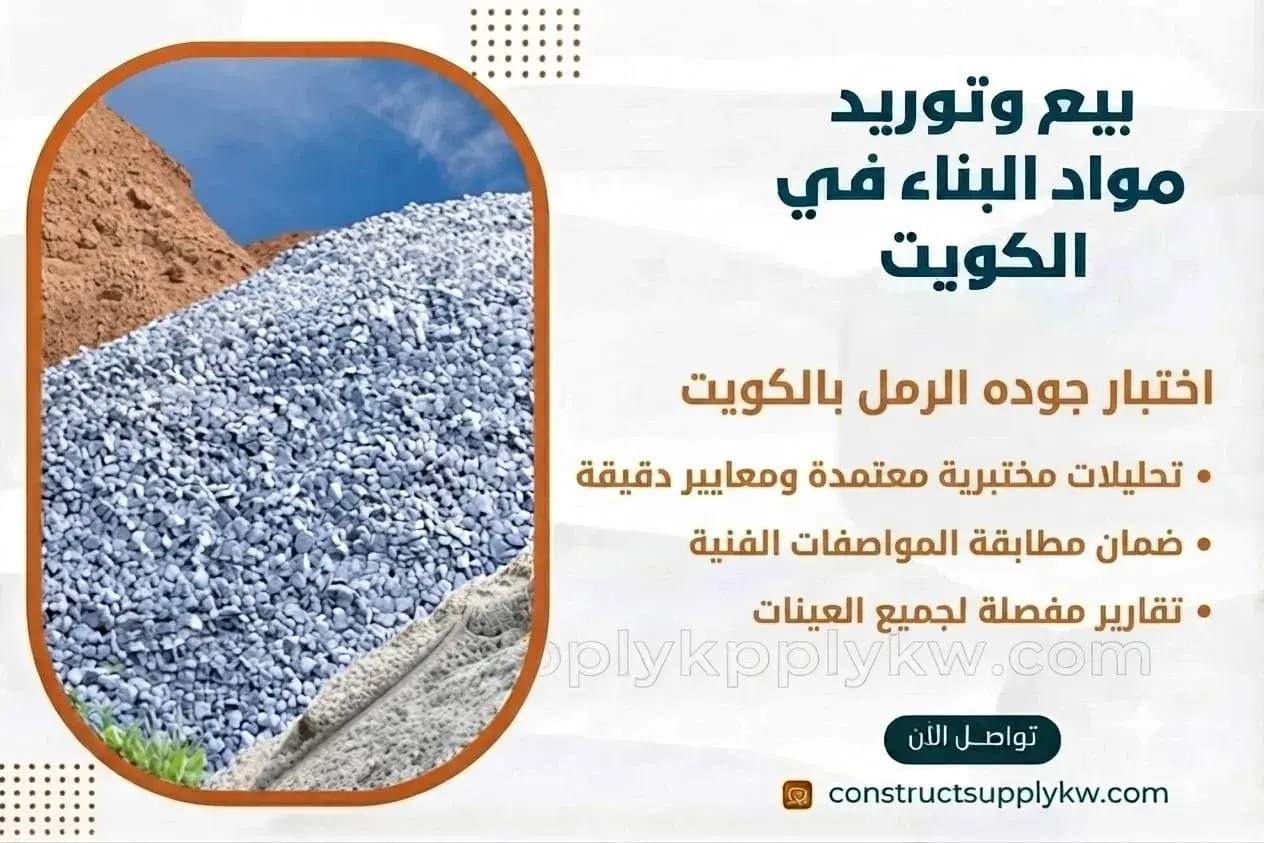
Sand quality testing is one of the most important procedures performed before approving any supplier for professional construction projects because the visual appearance of sand alone is never sufficient to determine whether it is suitable for plastering, rendering, or finishing applications. Sand may appear clean and uniform, yet laboratory testing can reveal excessive amounts of fine materials, salts, clay, or organic contaminants that significantly reduce mortar quality and long-term durability. For this reason, engineering consultants and quality-control teams rely on a comprehensive series of standardized tests before approving sand for use on site.
These evaluations typically include sieve analysis to determine particle size distribution, measurements of fine material content, tests for organic impurities, salt analysis where required, and assessments of overall cleanliness and consistency between production batches. In major construction projects, random samples are frequently collected from newly delivered shipments to verify that every batch maintains the same engineering characteristics. This approach minimizes quality variations that could affect mortar performance or create inconsistencies in finished surfaces throughout the project.
Practical construction experience consistently demonstrates that the cost of laboratory testing is insignificant compared with the financial losses associated with using unsuitable sand. Problems such as weak bonding, surface cracking, poor finishing quality, or discoloration often require extensive repair work after project completion, making proper testing one of the most valuable investments in construction quality.
Engineering professionals also recommend that contractors never rely solely on supplier certificates. Independent laboratory verification should always be carried out, particularly for large commercial, government, or high-specification projects where construction quality must be fully documented.
-
Laboratory testing should always precede supplier approval.
-
Includes sieve analysis and fine material evaluation.
-
Detects harmful salts, clay, and organic contaminants.
-
Verifies consistency between production batches.
-
Reduces the risk of future finishing defects.
-
Supports engineering approval before construction begins.
-
Improves reliability in large-scale projects.
-
Prevents expensive repair and maintenance work.
-
Requires representative sampling from delivered materials.
-
Forms an essential part of construction quality-control systems.
Construction Sand Specifications
Construction sand specifications establish the engineering requirements that sand must satisfy before it can be approved for structural or finishing applications. These specifications extend far beyond particle size alone and include cleanliness, particle grading, freedom from salts, clay, organic materials, and consistency across production batches. Engineering standards define acceptable limits for each of these characteristics to ensure that sand performs reliably within mortar or concrete mixtures without reducing strength, durability, or service life.
Throughout Kuwait, professional contractors prefer working with suppliers capable of consistently providing washed construction sand that complies with recognized engineering specifications. The country's demanding environmental conditions require high-quality materials capable of maintaining stable performance despite elevated temperatures and prolonged exposure to harsh weather. Compliance with technical standards also enables engineers to predict mortar behavior more accurately during construction, reducing unexpected variations throughout the project.
The importance of engineering specifications extends beyond quality assurance. Consistent material properties allow construction teams to maintain uniform mix designs without repeatedly adjusting water or cement content during execution. This contributes to faster construction, improved finishing quality, reduced material waste, and more predictable project outcomes.
Engineering consultants also recommend maintaining laboratory reports and supplier quality documentation within the project's quality records, particularly for commercial, industrial, and government developments that require complete traceability of construction materials.
-
Defines the engineering requirements for construction sand.
-
Covers cleanliness, grading, and impurity limits.
-
Ensures consistent material performance.
-
Helps standardize quality throughout the project.
-
Reduces unnecessary mix adjustments.
-
Supports premium plastering and finishing quality.
-
Used by engineering consultants during supplier approval.
-
Improves reliability in major construction projects.
-
Simplifies quality-control procedures.
-
Forms the foundation for selecting suitable construction sand.
Plastering Sand
.webp)
Plastering sand is specifically selected for producing mortar used on walls and ceilings, making its engineering properties critical to achieving smooth, durable, and attractive finished surfaces. Successful plastering depends not only on skilled workmanship but also on selecting sand with appropriate fineness, balanced grading, excellent cleanliness, and superior workability. These characteristics enable the mortar to bond effectively, remain stable after curing, and minimize the likelihood of shrinkage or separation from the substrate over time.
Modern construction projects throughout Kuwait increasingly rely on washed sand specifically prepared for plastering, particularly in villas, residential developments, commercial buildings, and premium architectural projects where finishing quality directly influences customer satisfaction. Professional contractors avoid mixing plastering sand with other sand types having different engineering properties because such variations may alter mortar consistency and produce uneven surface quality across different areas of the project.
Field experience consistently shows that plastering sand directly affects cement consumption, application efficiency, finishing speed, and even the quality of decorative coatings applied later. Uneven or poorly prepared surfaces require additional grinding, filling, and correction before painting begins, increasing both labor costs and project duration.
Engineers also emphasize the importance of proper storage after delivery. Even premium-quality plastering sand can lose its engineering value if contaminated with soil, debris, or other materials while stored on the construction site.
-
Specifically intended for wall and ceiling plastering.
-
Produces smooth and uniform finished surfaces.
-
Requires balanced fineness and particle grading.
-
Washed sand is generally the preferred choice.
-
Influences cement consumption and application efficiency.
-
Reduces the need for corrective finishing work.
-
Improves the quality of paints and decorative finishes.
-
Must be stored carefully to preserve cleanliness.
-
Should not be mixed with incompatible sand sources.
-
Represents a key component of successful plastering systems.
Best Sand for Finishing
Selecting the best sand for finishing depends on meeting well-defined engineering criteria rather than simply choosing the lowest-priced material or the most familiar supplier. Premium finishing sand combines excellent cleanliness, balanced particle size distribution, appropriate fineness, freedom from salts and organic contaminants, and consistent quality across every delivery. When these characteristics are achieved together, plastering and finishing operations become more efficient while producing durable, attractive surfaces that require minimal maintenance throughout their service life.
In Kuwait, engineers generally recommend washed fine sand that complies with recognized engineering specifications for both interior and exterior finishing work. This type of sand offers excellent workability, improves mortar adhesion, and creates smooth surfaces ready for painting or decorative finishes with minimal preparation. Choosing a reliable supplier is equally important because consistent material quality ensures that identical finishing results are maintained throughout every phase of construction.
Practical construction experience repeatedly demonstrates that investing in premium raw materials from the beginning saves significant time, labor, and future repair costs. By contrast, selecting the cheapest available sand without verifying its engineering properties often results in defects that become apparent only after project completion, when corrective work is considerably more expensive.
For this reason, professional contractors focus on selecting the sand that delivers the best combination of engineering quality, ease of application, long-term durability, and finishing performance rather than simply pursuing the lowest purchase price.
-
Combines cleanliness, proper fineness, and balanced grading.
-
Should preferably be washed and free from contaminants.
-
Produces premium-quality architectural finishes.
-
Improves mortar adhesion to construction surfaces.
-
Reduces the likelihood of cracking and finishing defects.
-
Delivers consistent results throughout the project.
-
Selection should always be based on engineering specifications.
-
Reliable suppliers provide greater quality consistency.
-
Helps reduce long-term maintenance costs.
-
Represents the preferred choice for professional finishing applications.
Conclusion
Fine concrete sand is one of the most important materials influencing the success of plastering, rendering, and finishing work because it directly affects mortar quality, workability, surface appearance, and long-term durability. Throughout this guide, we have examined the engineering characteristics of fine concrete sand, the importance of particle size distribution, the role of sand fineness, the advantages of washed fine sand, essential quality testing procedures, construction sand specifications, plastering sand applications, and the factors that determine the best sand for professional finishing work. Practical engineering experience consistently confirms that selecting high-quality sand at the beginning of a project significantly improves construction quality while reducing maintenance requirements and costly repairs. Ultimately, the performance of any finishing system begins with choosing the right raw material according to recognized engineering standards rather than focusing solely on cost.
Frequently Asked Questions
What is fine concrete sand?
Fine concrete sand is carefully graded sand with small particle sizes that is commonly used in plastering, rendering, and certain precision concrete applications requiring smooth, high-quality finishes.
Is plaster sand different from concrete sand?
Yes. Plaster sand is generally finer and specifically engineered to produce mortar that spreads easily while creating smooth, uniform finishing surfaces.
Why is washed sand recommended?
Because washing removes clay, salts, dust, and organic contaminants that can reduce mortar bonding, finishing quality, and long-term durability.
How is sand quality tested?
Quality is evaluated through sieve analysis, measurements of fine material content, impurity testing, salt analysis where required, and verification that the sand complies with engineering specifications.
Does sand fineness affect plaster quality?
Yes. Proper fineness improves workability and finishing quality, whereas excessively fine or excessively coarse sand can negatively affect mortar performance and surface appearance.
What is the best sand for finishing?
Washed fine sand with balanced particle grading, excellent cleanliness, and compliance with engineering standards is generally considered the best choice for professional finishing applications.
Can any type of sand be used for plastering?
No. Using unsuitable sand may reduce mortar adhesion, increase cracking, and significantly lower the overall quality and durability of finished surfaces.
How should sand be stored on site?
Sand should be stored in a clean, protected area where it cannot become contaminated by soil, debris, standing water, or other construction materials before use.


.jpeg)