Large-format porcelain slabs have become one of the defining trends in modern residential and commercial finishing projects because they create a luxurious appearance, minimize grout joints, and contribute to clean contemporary architectural designs. However, the long-term success of these installations depends not only on the quality of the porcelain itself but also on selecting the correct porcelain tile adhesive that can safely support the slab's dimensions and weight while maintaining reliable bond strength for many years. This consideration is especially important in Kuwait, where extreme temperatures and continuous thermal expansion and contraction place additional stress on construction materials. As a result, choosing the appropriate adhesive has become an engineering decision rather than a simple purchasing choice. This guide explains the essential specifications required for adhesives used with large-format porcelain slabs, highlights the differences between available products, discusses the most important selection criteria, and examines the installation mistakes that should be avoided to achieve durable, professional results.
Porcelain Tile Adhesive
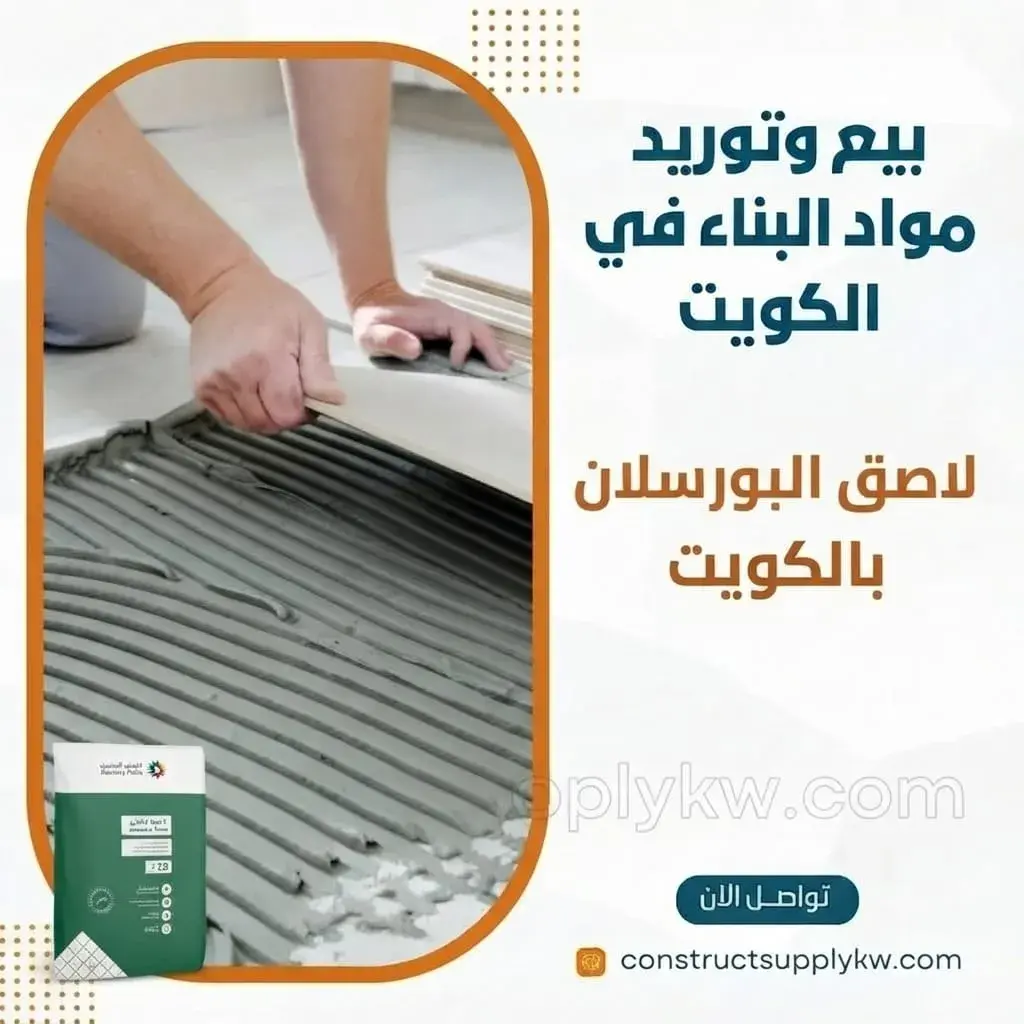
Porcelain tile adhesive differs fundamentally from adhesives designed for conventional ceramic tiles because porcelain has an extremely low water absorption rate, making it considerably more challenging to achieve a strong mechanical and chemical bond. Manufacturers therefore develop specialized adhesive formulations containing advanced polymer additives that significantly improve adhesion to the dense back surface of porcelain tiles. These enhanced properties become even more important with large-format porcelain slabs that may extend several meters in length, where the increased weight places substantially greater loads on the adhesive layer. Experience gained from numerous construction projects throughout Kuwait consistently demonstrates that many cases of porcelain slab failure are not caused by poor tile quality but by selecting adhesives that were never designed for this type of installation or by improper application techniques. Professional engineers therefore evaluate several critical factors before choosing an adhesive, including porcelain type, installation location, substrate characteristics, moisture exposure, thermal conditions, slab dimensions, and overall panel weight. It is equally important to verify compatibility between the adhesive and the tile manufacturer's installation recommendations because certain porcelain manufacturers specify approved adhesive systems to preserve warranty coverage. Selecting the correct porcelain adhesive establishes the foundation for a successful installation by ensuring long-term slab stability while minimizing the likelihood of hollow spots, debonding, cracking, or other performance problems during years of service.
-
Specifically formulated for porcelain's extremely low water absorption.
-
Provides stronger adhesion than conventional ceramic tile adhesives.
-
Suitable for large-format slabs when the correct product is selected.
-
Delivers optimum performance only when preparation and installation are properly executed.
-
Contains advanced polymer additives that improve flexibility and durability.
-
Reduces the likelihood of slab detachment during long-term service.
-
Supports modern residential and commercial construction projects.
-
Requires strict compliance with manufacturer installation instructions.
-
Extends the service life of premium finishing systems.
-
Serves as the foundation for successful porcelain slab installations.
Large Format Slab Adhesive
Large format slab adhesive must satisfy performance requirements that exceed those of adhesives used for conventional tile installations because increased slab dimensions create greater weight, larger bonding surfaces, and higher exposure to stresses caused by structural movement and thermal expansion. Consequently, the adhesive must provide more than simply high bond strength. It must also distribute loads uniformly beneath the entire slab while maintaining sufficient flexibility to absorb movement without transferring excessive stress directly into the porcelain. Practical experience from premium construction projects demonstrates that using an adhesive not specifically developed for large-format slabs frequently results in hollow sounds beneath the surface or partial slab separation after a period of service, even when the installation initially appears successful. Leading international manufacturers therefore develop products specifically engineered for these demanding applications, providing complete back coverage, exceptional adhesion, and excellent workability during installation. Professional installers commonly employ the double-spreading method by applying adhesive both to the substrate and to the back of the slab to eliminate trapped air pockets and maximize contact. Adequate open time and working time are equally important because positioning and adjusting large slabs requires considerably more time than installing conventional tiles. Selecting the correct adhesive therefore becomes one of the most decisive factors influencing installation quality and long-term reliability.
-
Supports the increased weight of modern large-format slabs.
-
Promotes uniform load distribution beneath each installed slab.
-
Reduces the formation of air pockets beneath porcelain panels.
-
Designed specifically for luxury finishing projects using oversized porcelain.
-
Compatible with double adhesive application techniques.
-
Provides sufficient working time for large slab positioning.
-
Ensures complete coverage across the entire back surface.
-
Minimizes the risk of long-term slab separation.
-
Delivers the best results when installed by experienced professionals.
-
Improves both appearance and structural stability of finished installations.
Flexible Porcelain Adhesive
Flexibility is one of the most valuable characteristics of flexible porcelain adhesive, particularly in projects exposed to continuous temperature fluctuations or minor structural movement. Flexibility should never be confused with weakness. Instead, it refers to the adhesive's ability to absorb stresses generated by thermal expansion and contraction without losing bond strength or transferring those forces directly into the porcelain slab itself. In Kuwait, where façades and exposed surfaces experience extremely high temperatures throughout the summer, flexible adhesives have become essential for numerous exterior applications as well as selected interior installations with demanding performance requirements. Large-format slabs increase the importance of flexibility because their greater dimensions expose them to higher levels of movement generated by changes in substrate temperature. Practical experience consistently demonstrates that many long-term installation problems can be significantly reduced by selecting adhesives with flexibility appropriate for the intended application. Nevertheless, even the most flexible adhesive cannot replace properly designed movement joints, thorough substrate preparation, or compliance with installation procedures because successful performance always depends on the complete installation system rather than on a single material. Engineers therefore evaluate adhesive flexibility together with every other project requirement before making their final product selection.
-
Absorbs stresses created by thermal expansion and contraction.
-
Suitable for exterior applications and high-temperature environments.
-
Reduces stress transfer into porcelain slabs.
-
Extends the long-term durability of finished installations.
-
Performs exceptionally well with large-format porcelain panels.
-
Does not eliminate the need for properly designed movement joints.
-
Achieves optimum performance when installed according to technical specifications.
-
Improves safety in projects subject to structural movement.
-
Provides greater long-term installation stability.
-
Represents an essential solution for demanding engineering applications.
Large Format Porcelain Installation
Large format porcelain installation requires a substantially higher level of precision than conventional tile installation because the increased dimensions of each slab magnify the consequences of even the smallest preparation or installation error. Uneven substrates, inconsistent adhesive coverage, improper handling, or inaccurate positioning can all compromise the long-term performance of the finished installation. Unlike smaller tiles, large porcelain slabs cannot tolerate significant voids beneath their surface because concentrated stresses may eventually cause cracking, debonding, or structural instability. Professional installation therefore begins with a comprehensive evaluation of the substrate using precision leveling equipment to identify and correct any irregularities before adhesive application begins. Once the surface has been properly prepared, the adhesive is mixed exactly according to the manufacturer's instructions, and an appropriately sized notched trowel is used to produce a uniform adhesive layer. Most professional installers employ the double-buttering method by spreading adhesive both on the substrate and on the back of each slab to maximize contact area and eliminate trapped air. Specialized lifting frames, suction handling systems, and slab transport equipment are also commonly used to prevent bending, twisting, or accidental breakage during handling. Practical experience consistently demonstrates that most failures involving large porcelain panels result from installation shortcuts rather than deficiencies in the porcelain itself. Skilled installation teams continuously verify flatness, alignment, adhesive coverage, and working time throughout the installation process because the quality of every individual step directly influences the durability of the completed project.
-
Begin by correcting substrate flatness before applying adhesive.
-
Achieve nearly complete adhesive coverage beneath every porcelain slab.
-
Use professional handling equipment designed for oversized panels.
-
Require experienced installation teams familiar with large-format systems.
-
Respect the adhesive's specified open time throughout installation.
-
Maintain consistent adhesive thickness across the entire surface.
-
Continuously verify slab alignment and level during installation.
-
Reduce the likelihood of future cracking and debonding through proper workmanship.
-
Produce highly stable and visually consistent finished surfaces.
-
Depend on meticulous preparation as much as on adhesive quality.
Tile Slip Resistance
.webp)
Although tile slip resistance is primarily determined by the surface texture and finish of the porcelain itself, installation quality and adhesive performance indirectly contribute to achieving the expected safety level. A tile that is not fully supported because of inadequate adhesive coverage or hidden voids may experience slight movement under load, eventually affecting its long-term stability. Likewise, maintaining a perfectly level finished surface without excessive lippage between adjacent slabs helps reduce trip hazards while improving pedestrian safety, especially in commercial buildings and areas exposed to moisture. Engineers therefore select porcelain products according to the slip-resistance classification appropriate for the intended environment while simultaneously ensuring that installation procedures produce complete adhesive support and precise slab alignment. In Kuwait, higher slip-resistance ratings are commonly specified for exterior entrances, pool decks, terraces, and pedestrian walkways, whereas smoother finishes may be appropriate for dry interior residential spaces. It is important to recognize that even porcelain with excellent slip-resistance characteristics cannot perform as intended if poor installation practices compromise the stability or levelness of the finished floor. Consequently, installation quality forms an essential component of overall flooring safety rather than serving merely as an aesthetic consideration.
-
Safety depends on both tile selection and installation quality.
-
Precise leveling helps minimize trip hazards.
-
Complete adhesive coverage improves long-term floor stability.
-
Slip-resistance requirements vary according to the intended application.
-
Outdoor and wet environments demand greater slip resistance.
-
Engineers evaluate slip ratings before approving porcelain products.
-
Professional installation preserves long-term floor performance.
-
Uniform joint spacing contributes to overall installation quality.
-
Slip resistance should never be confused with adhesive bond strength.
-
Professionally installed flooring provides greater long-term user safety.
High Bond Strength Adhesive
High bond strength adhesive represents one of the most important components in successful large-format porcelain installations because it has been engineered to maintain exceptional adhesion even under demanding structural and environmental conditions. These advanced formulations contain specialized polymers and performance-enhancing additives that improve both initial grab and long-term bond strength while maintaining sufficient flexibility to accommodate normal building movement. Their advantages become particularly evident in exterior façades, shopping centers, public buildings, and other high-traffic environments where installation failures can lead to significant repair costs and operational disruption. Practical project experience shows that selecting a high bond strength adhesive is not solely about maximizing adhesive force. It also improves load distribution beneath the slab, minimizes trapped air pockets, and supports consistent long-term performance. However, these benefits can only be realized when the product is mixed, applied, and cured exactly as specified by the manufacturer. Proper adhesive thickness, substrate preparation, working time, and installation procedures remain essential elements of overall system performance. For this reason, engineers consider high bond strength adhesives as one component within an integrated installation system rather than viewing adhesive performance as an isolated characteristic.
-
Provides exceptional adhesion for heavy porcelain slabs.
-
Suitable for demanding structural and architectural applications.
-
Reduces the likelihood of long-term slab separation.
-
Promotes more uniform load distribution beneath porcelain panels.
-
Performs effectively in both interior and appropriate exterior applications.
-
Requires correct installation procedures to achieve full performance.
-
Supports modern installation systems for oversized porcelain.
-
Increases long-term reliability of finished projects.
-
Helps reduce maintenance costs caused by inadequate adhesion.
-
Provides greater confidence in installation durability over time.
Porcelain Fixing
Porcelain fixing involves far more than simply applying adhesive and positioning porcelain slabs. It is a comprehensive engineering process designed to provide permanent stability while preserving the quality and appearance of the finished installation throughout the building's service life. The process begins by verifying that the substrate possesses sufficient structural integrity to support the anticipated loads before selecting the most appropriate installation system according to slab dimensions, installation location, and service conditions. When large-format porcelain slabs are involved, adhesive coverage becomes particularly important. Professional installation practices recommend achieving the highest possible percentage of continuous contact beneath each slab to eliminate voids that could later become structural weak points. Installers also pay careful attention to the direction in which adhesive ridges are combed so that trapped air can escape as the slab is pressed into position. Professional leveling systems are then used to eliminate height differences between adjacent slabs and create a perfectly uniform finished surface. Practical experience consistently demonstrates that projects following these procedures achieve superior long-term performance while significantly reducing maintenance requirements. Installers must also respect the adhesive manufacturer's recommended curing period before allowing pedestrian traffic or heavy loading because premature use may reduce the final bond strength. Successful porcelain fixing therefore depends on the combined performance of the adhesive, installation technique, substrate preparation, professional workmanship, and full compliance with engineering specifications from the beginning of the project through final completion.
-
Begin with careful evaluation of substrate structural integrity.
-
Achieve maximum possible adhesive coverage beneath every slab.
-
Use professional leveling systems to eliminate uneven slab edges.
-
Comb adhesive in a consistent direction to reduce trapped air.
-
Respect full curing time before allowing traffic on the finished surface.
-
Follow technical specifications throughout every installation stage.
-
Reduce the likelihood of long-term movement or debonding.
-
Deliver durable stability for floors and wall installations.
-
Suitable for premium residential and commercial developments.
-
Reflect installation quality rather than simply adhesive performance.
Porcelain Adhesive Specifications
The specifications of porcelain adhesive serve as the primary technical benchmark for determining whether a product is suitable for large-format porcelain slabs. Choosing an adhesive based only on brand recognition or marketing claims is never sufficient because every installation has unique engineering requirements. A professional evaluation begins by reviewing the adhesive classification, initial and final bond strength, slip resistance for vertical applications, open time, pot life, flexibility, deformability, and compatibility with low-absorption porcelain tiles. The technical data sheet should also specify the recommended adhesive bed thickness, mixing ratio, installation temperature range, curing conditions, and approved applications for both interior and exterior projects. These technical characteristics are essential because large-format porcelain slabs demand higher installation accuracy and more consistent adhesive performance than conventional ceramic tiles. On professionally managed construction projects, engineers review laboratory certifications and compliance reports before approving any adhesive to verify that its performance has been independently tested according to recognized international standards. These documents also confirm manufacturing consistency from one production batch to another, reducing the risk of unexpected variations during installation. Reviewing technical specifications allows contractors to compare products objectively rather than relying on advertising or price alone. When purchasing decisions are based on verified technical performance instead of assumptions, installation quality improves, maintenance requirements decrease, and the overall reliability of the finished porcelain system increases throughout its service life.
-
Include internationally recognized adhesive classifications and performance ratings.
-
Specify bond strength under various environmental conditions.
-
Confirm compatibility with low-water-absorption porcelain slabs.
-
Provide recommended adhesive thickness and mixing procedures.
-
Define flexibility and deformability characteristics.
-
Explain approved applications for interior and exterior installations.
-
Support objective comparison between competing products.
-
Include laboratory certifications and compliance documentation.
-
Help engineers select products that match project requirements.
-
Reduce installation failures caused by unsuitable adhesive selection.
Exterior Porcelain Adhesive
Exterior porcelain adhesive operates under some of the most demanding conditions encountered in tile installation because exterior porcelain surfaces are continuously exposed to sunlight, intense heat, moisture, seasonal weather changes, and repeated cycles of thermal expansion and contraction. In Kuwait, façade systems, terraces, balconies, and outdoor walkways may experience extremely high surface temperatures during the summer months, placing significant stress on both the porcelain slabs and the adhesive layer beneath them. For this reason, exterior adhesives must combine exceptional bond strength with high flexibility while maintaining long-term durability under severe environmental conditions. Products developed specifically for exterior porcelain installations are formulated to resist weather-related deterioration while preserving stable adhesion despite constant thermal movement. However, selecting the correct adhesive alone does not guarantee successful performance. Proper movement joints, complete adhesive coverage, accurate substrate preparation, and professional installation practices remain equally important components of the overall installation system. Weak substrates or poorly prepared surfaces can compromise even the highest-quality adhesive products. Practical experience consistently demonstrates that projects following complete engineering recommendations achieve substantially longer service lives and significantly lower maintenance costs than installations relying on inappropriate products or shortcuts during execution. Exterior porcelain systems therefore perform best when every component of the installation is designed to work together under real operating conditions.
-
Designed to withstand severe weather and elevated temperatures.
-
Provide reliable adhesion for façades, terraces, and balconies.
-
Maintain flexibility during continuous thermal movement.
-
Suitable for large-format exterior porcelain slabs.
-
Require professionally designed movement joints.
-
Depend on proper substrate preparation for maximum performance.
-
Minimize long-term slab separation and maintenance.
-
Meet the demands of modern exterior architectural projects.
-
Improve long-term durability in harsh climates.
-
Deliver stable performance under demanding environmental conditions.
Best Adhesive for Large Format Slabs
There is no single product that can universally be described as the best adhesive for large format slabs, because the ideal choice always depends on the specific requirements of the project rather than on a brand name alone. Professional selection begins by evaluating slab dimensions, installation location, substrate condition, environmental exposure, structural movement, and the expected service conditions throughout the life of the building. Engineers typically prioritize products that combine high bond strength, excellent flexibility, sufficient open time, easy workability, compatibility with low-absorption porcelain, and independently verified compliance with recognized international standards. Technical support provided by the manufacturer, clear installation documentation, consistent product availability, and manufacturing quality control are also important considerations, particularly on large commercial projects where material consistency is essential from beginning to end. Practical experience repeatedly demonstrates that the most successful installations result from selecting an adhesive that matches the technical demands of the project instead of simply purchasing the least expensive option. A small saving during material procurement can ultimately lead to far greater repair costs if an unsuitable adhesive causes slab movement or installation failure. For this reason, the best adhesive should always be viewed as the product whose technical performance, engineering certification, and installation characteristics align most closely with the project's specific requirements rather than the one with the most recognizable commercial name.
-
Combines outstanding bond strength with long-term flexibility.
-
Fully compatible with large-format porcelain slab installations.
-
Provides sufficient working time for accurate slab positioning.
-
Selected according to project-specific engineering requirements.
-
Supported by recognized technical certifications and testing.
-
Promotes complete adhesive coverage beneath oversized slabs.
-
Helps minimize future maintenance and repair costs.
-
Demonstrates consistent manufacturing quality across production batches.
-
Includes comprehensive technical documentation and installation guidance.
-
Represents a long-term investment in installation reliability and building performance.
Conclusion
Large-format porcelain slabs have become a defining feature of contemporary architectural design, but achieving their full performance potential depends on selecting the correct porcelain tile adhesive for every installation. Throughout this guide, we examined the engineering principles behind porcelain adhesives, products specifically designed for oversized slabs, the importance of adhesive flexibility, professional installation methods, the relationship between installation quality and slip resistance, the role of high bond strength adhesives, proper porcelain fixing techniques, the technical specifications that should guide adhesive selection, the requirements for exterior porcelain installations, and the criteria used to identify the most suitable adhesive for large-format slabs. When certified products are combined with professional workmanship, careful substrate preparation, and full compliance with manufacturer recommendations, porcelain slab installations achieve superior durability, exceptional stability, and long-term aesthetic performance even under demanding operating conditions.
Frequently Asked Questions
Do large-format porcelain slabs require a specialized adhesive?
Yes. Large-format porcelain slabs require adhesives specifically engineered to provide high bond strength, sufficient flexibility, and nearly complete contact beneath the slab to ensure long-term structural stability and reliable performance.
Why is the double-spreading method recommended for large porcelain slabs?
Applying adhesive to both the substrate and the back of the slab significantly improves surface coverage, eliminates air voids, increases bond strength, and reduces the likelihood of future debonding or cracking.
Can ordinary tile adhesive be used for exterior porcelain installations?
No. Exterior porcelain applications require adhesives specifically formulated to withstand temperature fluctuations, moisture, weather exposure, and continuous thermal movement while maintaining reliable long-term adhesion.
Which specifications are most important when selecting porcelain adhesive?
The most important specifications include adhesive classification, bond strength, flexibility, open time, slip resistance, compatibility with low-absorption porcelain, compliance with recognized international standards, and independent laboratory certifications.
How should the best adhesive for large-format porcelain slabs be selected?
The correct adhesive should be selected according to slab dimensions, installation location, substrate condition, environmental exposure, engineering requirements, and verified technical performance rather than relying solely on price or brand reputation.
.webp)
.webp)