6 mm BRC Mesh The Best Choice for Floors and Concrete Slabs
mm BRC mesh is one of the most widely used welded 6 reinforcement products for concrete floors and slabs that require uniformly distributed reinforcement, efficient installation, and consistent structural performance. It has become a preferred solution among engineers and contractors in Kuwait because it offers an excellent balance between structural efficiency, installation speed, and reduced material waste when compared with conventional reinforcement using individual reinforcing bars. However, selecting the appropriate BRC mesh involves much more than choosing the wire diameter. Engineers must also evaluate mesh spacing, wire spacing, welding quality, sheet dimensions, and compliance with recognized engineering standards. In this article, we examine the characteristics of 6 mm BRC mesh, its primary applications, the factors involved in selecting the correct mesh specification, and the most common mistakes that should be avoided to ensure durable concrete floors and slabs with excellent structural stability and a long service life.
6 mm BRC Mesh
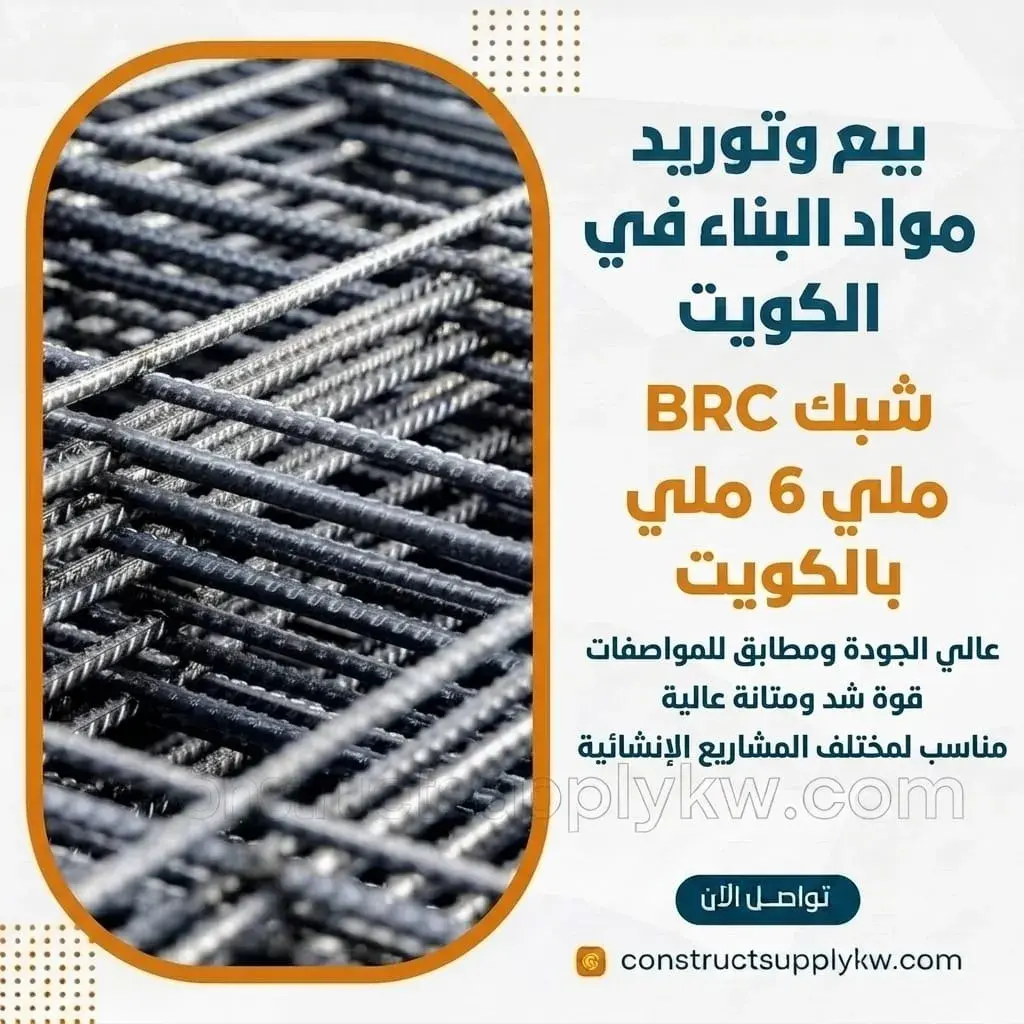
6 mm BRC Mesh is widely used in construction projects that require uniform reinforcement for concrete floors and slabs subjected to moderate service loads. The mesh is manufactured from high-quality steel wires that are electrically resistance welded at every intersection according to precisely controlled dimensions, ensuring consistent reinforcement distribution throughout the concrete element. This manufacturing process provides a much higher degree of accuracy than manually tying reinforcing bars on site while significantly reducing the possibility of errors in spacing or reinforcement layout. Construction projects throughout Kuwait demonstrate that 6 mm BRC mesh is frequently specified for light industrial floors, warehouses, residential buildings, utility areas, and similar applications because it provides effective crack control against shrinkage, temperature variations, and normal service loads. Its rapid installation also reduces construction time and lowers labor requirements compared with conventional reinforcement methods, improving both project efficiency and overall cost performance. Nevertheless, it is essential to emphasize that 6 mm BRC mesh should only be used where approved by the structural design, as selecting reinforcement diameter is always based on engineering calculations rather than individual preference or field experience.
-
Provides highly uniform reinforcement distribution throughout concrete slabs.
-
Reduces installation errors associated with manually tied reinforcement.
-
Suitable for moderate-load floor systems when specified by structural design.
-
Accelerates reinforcement installation on construction sites.
-
Minimizes material waste compared with conventional reinforcement.
-
Manufactured with consistently accurate mesh openings.
-
Helps control concrete shrinkage cracking.
-
Commonly used in residential, service, and light industrial projects.
-
Must always be installed according to approved structural drawings.
-
Represents one of the most frequently specified BRC mesh sizes for floor construction.
BRC Mesh for Floors
BRC Mesh for Floors represents one of the engineering solutions that has significantly improved the construction of concrete floor systems by providing prefabricated reinforcement sheets that can be installed rapidly while maintaining uniform steel distribution across the entire concrete slab. This consistency directly enhances the floor's ability to resist shrinkage cracking, temperature-related movement, and operational service loads throughout its lifetime. BRC floor mesh is suitable for numerous applications including villa floors, parking areas, warehouses, workshops, and selected commercial developments, provided that the mesh specification matches the structural engineer's design requirements. Using welded reinforcement also reduces the amount of manual tying required on site, substantially shortening installation time while minimizing human error. Practical experience from construction projects across Kuwait consistently demonstrates that installing the mesh on properly positioned reinforcement chairs while maintaining the specified concrete cover produces significantly better structural performance than placing reinforcement directly on the blinding layer or waterproof membrane. The position of reinforcement within the concrete section remains one of the most important factors affecting the structural efficiency and durability of any reinforced concrete floor.
-
Creates uniform reinforcement across the entire floor slab.
-
Helps minimize shrinkage-related concrete cracking.
-
Suitable for parking areas and residential floor construction.
-
Reduces reinforcement installation time.
-
Requires concrete cover that complies with structural specifications.
-
Should always be supported using reinforcement chairs.
-
Improves the overall quality of concrete floor construction.
-
Minimizes manual reinforcement tying.
-
Enhances construction efficiency on large projects.
-
Must always be selected according to structural engineering requirements.
Concrete Slab Reinforcement Mesh

Concrete Slab Reinforcement Mesh provides a practical reinforcement solution for many reinforced concrete slabs requiring consistent steel distribution together with rapid installation and dependable construction quality. Unlike individually placed reinforcing bars, welded reinforcement mesh is factory manufactured under controlled conditions with fixed dimensions and accurately maintained spacing, dramatically reducing installation inconsistencies during on-site construction. Concrete slabs depend upon balanced reinforcement distribution to control tensile stresses effectively, and the uniform geometry of welded mesh contributes significantly to this performance, particularly in slabs subjected to evenly distributed service loads. Practical construction experience demonstrates that BRC mesh improves installation quality while reducing labor time whenever used within applications approved by structural design. However, it should never be considered a universal replacement for conventional reinforcing bars because numerous structural situations require additional reinforcement, localized strengthening, or specially detailed reinforcement according to engineering calculations. Consequently, the decision to use concrete slab reinforcement mesh should always originate from the structural engineer responsible for the project rather than from installation convenience or cost considerations alone.
-
Provides accurate reinforcement distribution throughout concrete slabs.
-
Factory manufacturing minimizes installation inaccuracies.
-
Helps control cracking within reinforced concrete slabs.
-
Shortens reinforcement preparation time.
-
Particularly effective in slabs carrying distributed loads.
-
May require additional reinforcement depending on structural design.
-
Maintains consistent spacing between reinforcing wires.
-
Improves construction quality compared with many traditional methods.
-
Selection must always follow structural engineering calculations.
-
Delivers excellent performance when specified for appropriate applications.
Welded BRC Mesh
Welded BRC Mesh is manufactured using highly accurate electrical resistance welding equipment that permanently joins every wire intersection under carefully controlled factory conditions. This manufacturing method differs fundamentally from manually tying reinforcing bars with binding wire because product quality depends upon automated production systems rather than individual workmanship. The welding process not only secures the wires during transportation and handling but also preserves precise reinforcement spacing throughout installation, enabling construction teams to follow structural drawings with greater consistency. Construction experience from residential developments, warehouses, factories, and commercial projects throughout Kuwait clearly demonstrates that welded BRC mesh has become the preferred reinforcement solution wherever rapid construction and reliable reinforcement quality are equally important, especially for large floor areas where manually assembling reinforcement would require considerably more labor and time. Nevertheless, contractors should always verify that the mesh complies with recognized engineering standards and carefully inspect welded intersections before installation to ensure there are no damaged or separated welds that could affect handling or construction quality.
-
Manufactured automatically to ensure consistent weld quality.
-
Maintains accurate wire spacing during transportation and installation.
-
Reduces dependence on manual reinforcement tying.
-
Shortens reinforcement preparation for floors and slabs.
-
Improves productivity on large construction projects.
-
Delivers greater dimensional accuracy than manually assembled reinforcement.
-
Requires visual inspection of weld integrity before installation.
-
Reduces construction errors caused by human workmanship.
-
Suitable for projects requiring both speed and quality.
-
Overall performance depends upon manufacturing quality and compliance with specifications.
BRC Mesh Sizes
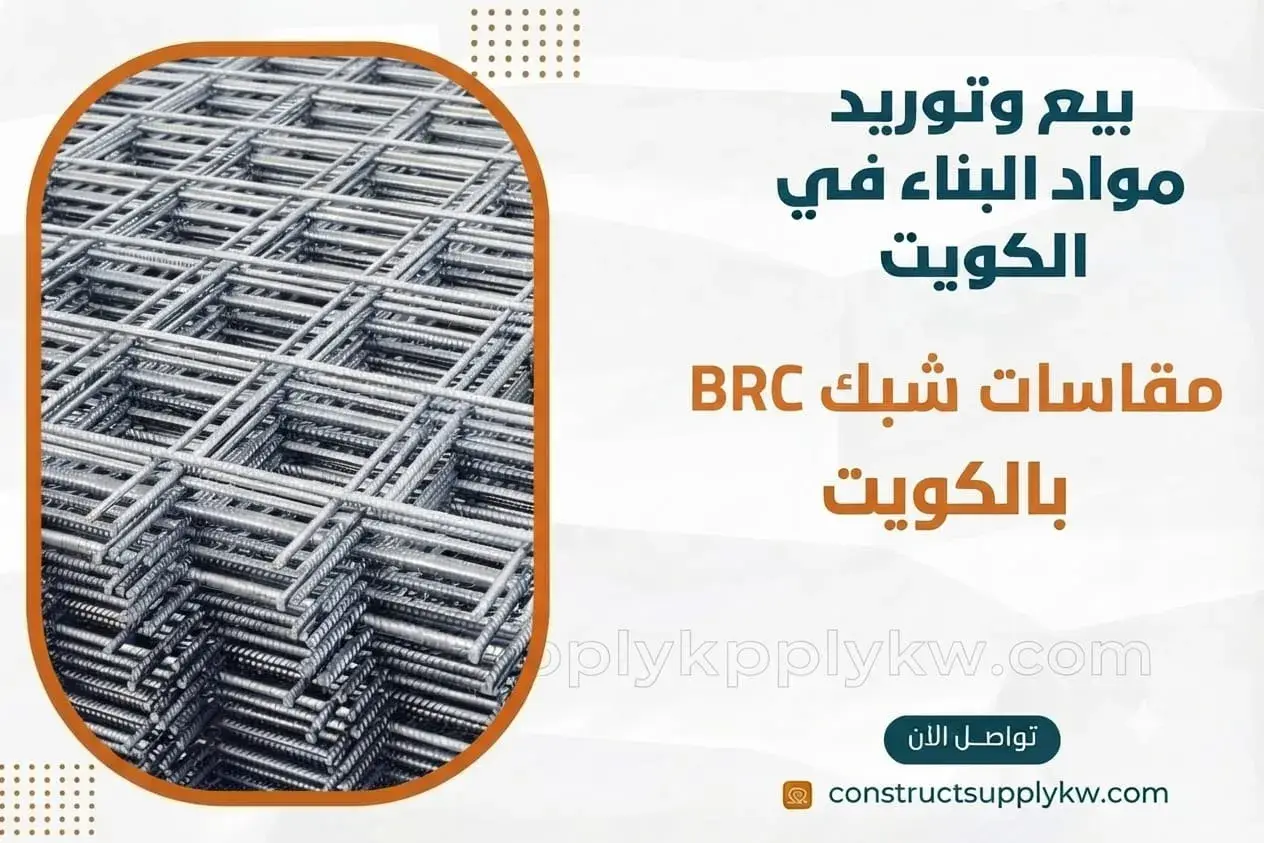
BRC Mesh Sizes include numerous combinations of wire diameters, mesh spacing, and sheet dimensions designed to satisfy different structural requirements. Selecting the correct mesh therefore involves considerably more than simply choosing the wire diameter. Wire diameter, mesh spacing, and overall sheet dimensions together determine the quantity of reinforcing steel provided per square meter as well as the structural performance of the reinforcement. While 6 mm mesh is suitable for many applications, other projects may require larger wire diameters or different spacing depending entirely upon structural calculations. Sheet dimensions may also vary between manufacturers according to production capabilities and market requirements, making it essential to verify product data before procurement rather than assuming every sheet is identical. Structural engineers routinely compare the specified mesh designation with the manufacturer's published wire diameter, spacing, and weight to confirm complete compliance with project requirements. Practical experience from projects across Kuwait demonstrates that verifying these specifications before delivery prevents costly construction delays caused by receiving reinforcement that does not match approved structural drawings.
-
Available in multiple wire diameters for different structural applications.
-
Wire spacing determines the amount of reinforcement within the mesh.
-
Sheet dimensions may differ between manufacturers.
-
Mesh designations must match approved structural drawings.
-
Selection depends on far more than wire diameter alone.
-
Different projects require different mesh configurations.
-
Product verification helps prevent procurement mistakes.
-
Sheet dimensions influence transportation and installation.
-
Structural engineers determine the appropriate mesh size.
-
Reinforcement should always be purchased from suppliers providing complete technical specifications.
BRC Mesh Weight
BRC Mesh Weight is one of the key technical indicators used by engineers and contractors to verify whether a reinforcement product complies with project specifications because sheet weight is directly related to wire diameter, wire spacing, and overall sheet dimensions. Consequently, visual inspection alone is never sufficient during material acceptance. Contractors should compare the published sheet weight with manufacturer data and approved structural drawings before authorizing installation. Significant weight discrepancies may indicate differences in wire diameter or spacing that directly affect the amount of reinforcement incorporated into the concrete structure. It is equally important to recognize that sheet weight naturally varies according to sheet dimensions, making it inappropriate to compare two different mesh sizes solely by weight. Professional construction projects throughout Kuwait routinely verify product certificates together with visual inspections to confirm that sheet dimensions, weight, and reinforcement specifications fully comply with project requirements before the mesh is incorporated into the structure. Discovering discrepancies after reinforcement installation can delay construction and significantly increase project costs.
-
Sheet weight reflects wire diameter and mesh dimensions.
-
Used to verify compliance with project specifications.
-
Different sheet sizes should never be compared by weight alone.
-
Helps identify discrepancies before construction begins.
-
Must correspond with manufacturer technical data.
-
Forms part of standard material acceptance procedures.
-
Influences the amount of reinforcement provided.
-
Should always be reviewed together with product certificates.
-
Helps ensure compliance with structural drawings.
-
Prevents the use of reinforcement that fails to meet specifications.
Mesh Wire Spacing
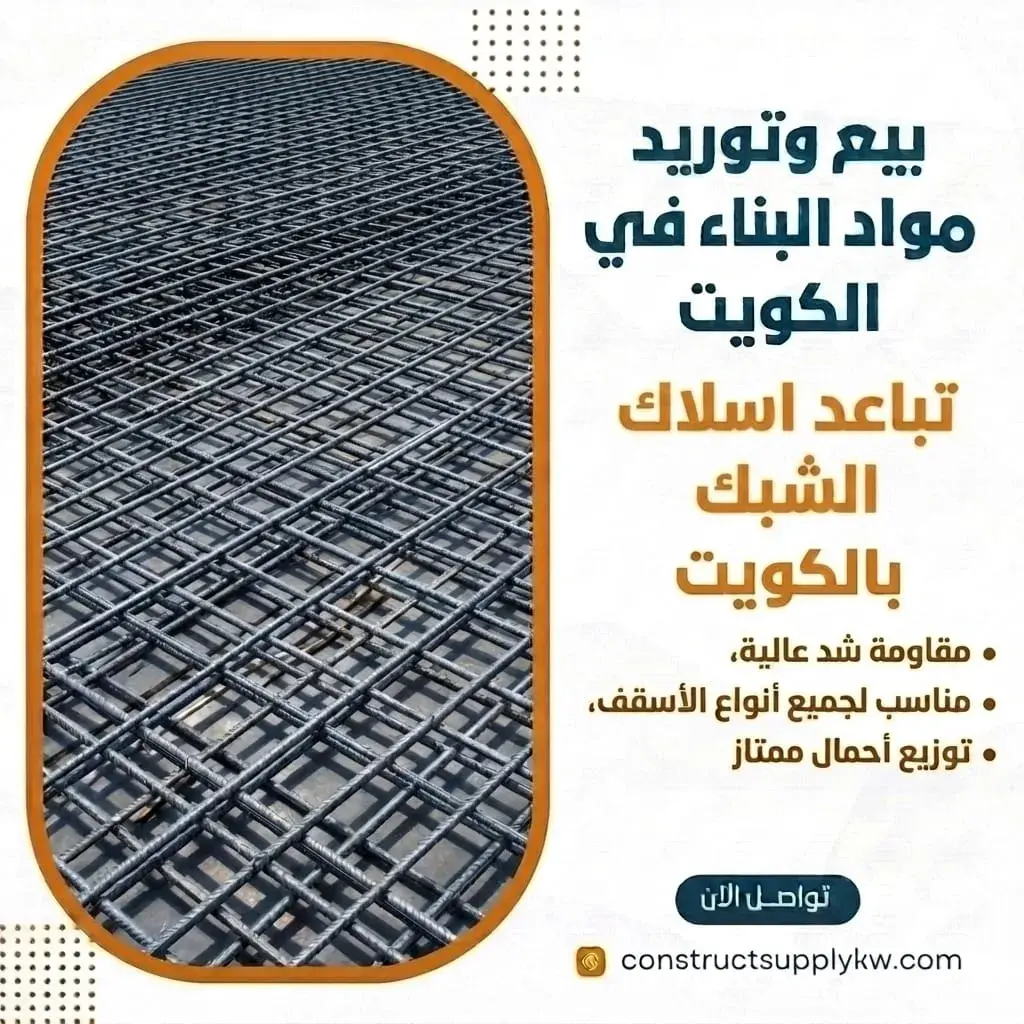
Mesh Wire Spacing directly influences reinforcement distribution throughout the concrete element as well as the quantity of reinforcing steel provided per square meter, making it one of the most important parameters evaluated by structural engineers during reinforcement selection. Any change in wire spacing alters the structural characteristics of the reinforcement mesh, affecting its ability to distribute stresses and control shrinkage or service-load cracking. Selecting appropriate spacing is therefore never an arbitrary decision but rather one determined by structural calculations, the type of reinforced concrete element, and anticipated loading conditions throughout the structure's service life. Contractors must also preserve the specified mesh orientation during installation and avoid making unauthorized field modifications that could disturb reinforcement distribution. Practical construction experience consistently demonstrates that maintaining the spacing specified on structural drawings enables the reinforcement to perform as intended while significantly reducing the likelihood of structural deficiencies or undesirable cracking after the building enters service.
-
Directly affects the amount of reinforcing steel within the mesh.
-
Promotes uniform stress distribution throughout concrete.
-
Helps control shrinkage-related cracking.
-
Determined entirely by structural engineering calculations.
-
Must be maintained accurately during installation.
-
Should never be modified without engineering approval.
-
Influences the structural performance of floors and slabs.
-
Evaluated together with wire diameter and sheet dimensions.
-
Maintains consistent reinforcement throughout the concrete element.
-
Represents one of the most important specifications for BRC mesh.
Reinforcement of Concrete Floors
Reinforcement of Concrete Floors is one of the most critical stages that determines the long-term performance of a floor slab and its ability to withstand service loads and environmental changes throughout its design life. Although concrete possesses excellent compressive strength, it requires reinforcement to resist tensile stresses and to control cracking effectively. For this reason, BRC mesh has become one of the preferred reinforcement solutions because it provides uniform steel distribution throughout the floor whenever structural calculations approve its use. Proper installation begins with preparing the sub-base, accurately establishing floor levels, and positioning plastic or concrete reinforcement chairs that support the mesh at the elevation specified in the structural drawings. Placing the mesh directly on the blinding layer or waterproofing membrane significantly reduces its structural effectiveness regardless of the product's manufacturing quality. Engineers must also ensure that sheet overlaps comply with structural details and that reinforcement remains securely positioned throughout concrete placement. Practical experience from numerous construction projects across Kuwait consistently demonstrates that most floor performance problems originate not from poor-quality BRC mesh but from improper installation practices such as inadequate support chairs, insufficient concrete cover, or displacement of reinforcement during concrete pouring. Consequently, successful concrete floor reinforcement depends upon combining high-quality reinforcement products with accurate installation procedures and continuous engineering supervision from the beginning of construction until concrete placement is completed.
-
Construction should begin with a properly prepared and accurately leveled sub-base.
-
Reinforcement chairs must support the mesh at the specified structural elevation.
-
Sheet overlaps should follow approved structural detailing requirements.
-
Reinforcement should remain stable throughout concrete placement and vibration.
-
Promotes balanced stress distribution throughout the concrete floor.
-
Helps minimize shrinkage-related cracking over the service life.
-
Requires continuous engineering supervision during installation.
-
Overall performance depends as much on installation quality as on product quality.
-
Strict compliance with construction specifications ensures superior structural performance.
-
Represents one of the essential factors in producing durable reinforced concrete floors.
Welded Steel Reinforcement Mesh
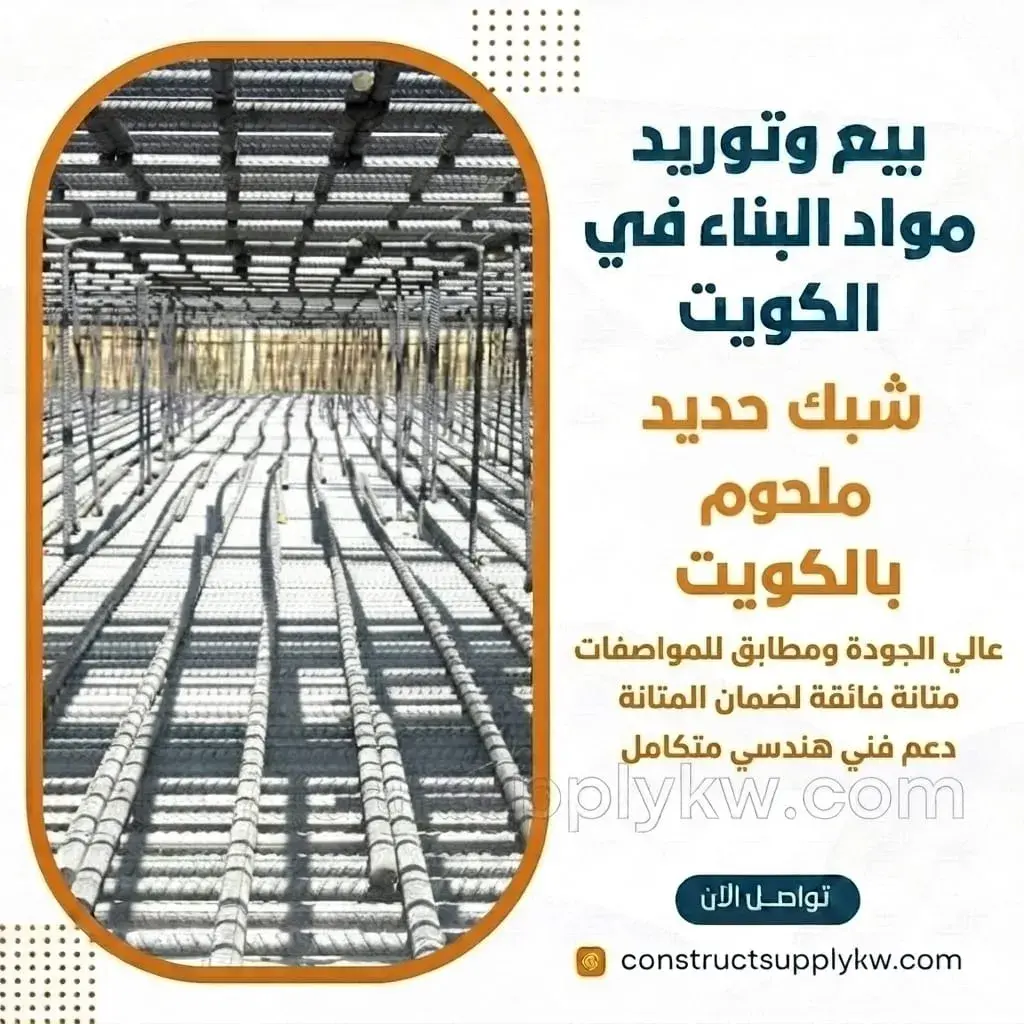
Welded Steel Reinforcement Mesh has fundamentally transformed reinforcement installation methods because it combines manufacturing precision, rapid installation, and reduced construction errors within a single engineered product. It is produced by electrically welding high-strength steel wires together at every intersection according to precisely controlled manufacturing standards, resulting in reinforcement sheets with fixed dimensions that cannot easily be replicated through manually tied reinforcing bars. The prefabricated sheets can be transported, positioned, and installed without repeatedly measuring the spacing between individual reinforcing bars, allowing construction teams to complete reinforcement work much more efficiently, especially across large floor areas. Welded steel mesh is used in numerous structural applications including concrete floors, slabs, selected reinforced walls, and certain precast concrete elements whenever structural design permits its use. Upon delivery to the construction site, engineers should inspect each sheet to verify that it remains straight, free from excessive deformation, and unaffected by transportation damage. Weld integrity should also be carefully examined before installation because preserving the condition of the reinforcement prior to placement contributes directly to the quality of the completed structure. For this reason, experienced contractors generally purchase welded reinforcement mesh only from reputable suppliers capable of providing technical documentation and certification demonstrating compliance with recognized engineering standards.
-
Manufactured under controlled factory conditions for maximum dimensional accuracy.
-
Reduces reinforcement layout errors during construction.
-
Easier to transport and install than individually tied reinforcing bars.
-
Suitable for numerous reinforced concrete applications when structurally approved.
-
Requires careful storage to maintain sheet alignment.
-
Weld quality should always be inspected before installation.
-
Significantly reduces reinforcement installation time.
-
Improves construction quality on both small and large projects.
-
Provides highly consistent reinforcement geometry.
-
Best obtained from suppliers offering certified products that comply with recognized engineering specifications.
BRC Mesh Specifications
BRC Mesh Specifications represent the primary engineering reference used to evaluate product quality and determine whether reinforcement is suitable for structural applications. Consequently, purchasing decisions should never rely solely on mesh size or wire diameter. Comprehensive specifications include steel grade, wire diameter, wire spacing, sheet dimensions, weld quality, manufacturing tolerances, and compliance with recognized engineering standards. Reliable manufacturers also provide technical certificates containing detailed product properties together with testing results confirming conformity with applicable specifications. Before approving any shipment, structural engineers routinely compare these technical documents with structural drawings to ensure complete compatibility between the delivered reinforcement and the project requirements. Installing reinforcement that fails to satisfy these specifications may result in rejection of delivered materials or costly replacement before concrete placement, causing unnecessary delays and additional project expenses. Practical construction experience throughout Kuwait consistently demonstrates that purchasing certified BRC mesh from trusted suppliers while carefully reviewing all technical specifications substantially reduces construction risks and provides both contractors and project owners with greater confidence in the long-term structural reliability of reinforcement that will remain permanently embedded within the concrete throughout the building's service life.
-
Specifications include wire diameter, spacing, and sheet dimensions.
-
Define manufacturing quality and weld performance requirements.
-
Must correspond precisely with approved structural drawings.
-
Technical certificates should accompany every shipment.
-
Help verify product quality before construction begins.
-
Reduce the likelihood of material rejection on site.
-
Contribute to the long-term safety of reinforced concrete structures.
-
Should always be reviewed before procurement approval.
-
Provide a reliable basis for comparing competing products.
-
Increase confidence in the quality and durability of installed reinforcement.
Conclusion
6 mm BRC Mesh has proven to be one of the most practical reinforcement solutions for concrete floors and slabs whenever it is selected according to approved structural engineering calculations and installed in full compliance with construction specifications. Throughout this article, we explored the characteristics of 6 mm BRC Mesh, the applications of BRC Mesh for Floors, the engineering role of Concrete Slab Reinforcement Mesh, the manufacturing advantages of Welded BRC Mesh, the importance of selecting appropriate BRC Mesh Sizes, the significance of BRC Mesh Weight, the structural influence of Mesh Wire Spacing, the principles of Reinforcement of Concrete Floors, the benefits of Welded Steel Reinforcement Mesh, and the critical BRC Mesh Specifications that should always be reviewed before procurement. When high-quality certified reinforcement is combined with professional installation under qualified engineering supervision, concrete floors achieve superior strength, long-term stability, effective crack control, and dependable structural performance throughout many years of service.
Frequently Asked Questions
Is 6 mm BRC mesh suitable for every type of concrete slab?
No. The appropriate reinforcement mesh must always be selected according to structural calculations, anticipated loading conditions, and the specific slab design. Engineers should never choose mesh size based solely on previous experience or convenience.
Can BRC mesh always replace conventional reinforcing bars?
No. While BRC mesh is highly effective for many floor and slab applications, certain structural elements require additional reinforcing bars, localized reinforcement, or specialized detailing that welded mesh alone cannot provide. Structural design determines the appropriate reinforcement system for each project.
Why are reinforcement chairs important when installing BRC mesh?
Reinforcement chairs maintain the mesh at the correct elevation within the concrete section, ensuring that the reinforcement performs exactly as intended by the structural design and provides the required structural capacity and crack control.
How can I verify the quality of BRC mesh before installation?
Quality should be verified by reviewing manufacturer certificates, confirming wire diameter, sheet dimensions, mesh spacing, weld integrity, and ensuring that the delivered product fully complies with the structural specifications established for the project.
Does mesh wire spacing affect the structural performance of a concrete floor?
Yes. Wire spacing directly influences reinforcement quantity, stress distribution, and crack control throughout the concrete floor. For this reason, spacing is established through structural engineering calculations and should never be altered during construction without engineering approval.