Selecting the appropriate aggregate size in concrete depends entirely on the structural element being constructed, which is why 3/8-inch crushed aggregate is not simply a smaller alternative to larger aggregate sizes but a deliberate engineering choice whenever greater precision and improved aggregate distribution are required in thin concrete sections or heavily reinforced structural elements. This aggregate size is widely used in concrete slabs, suspended ceilings, and specialized construction work where a more uniform surface finish is needed while minimizing the possibility of honeycombing or internal voids. In professional construction projects throughout Kuwait, engineers never choose aggregate based solely on particle size. Instead, they evaluate the relationship between aggregate type, concrete mix design, placement method, and the final finishing requirements. As a result, 3/8-inch crushed aggregate has become one of the preferred options for projects demanding exceptional construction quality, precise workmanship, and consistent structural performance.
3/8-Inch Crushed Aggregate
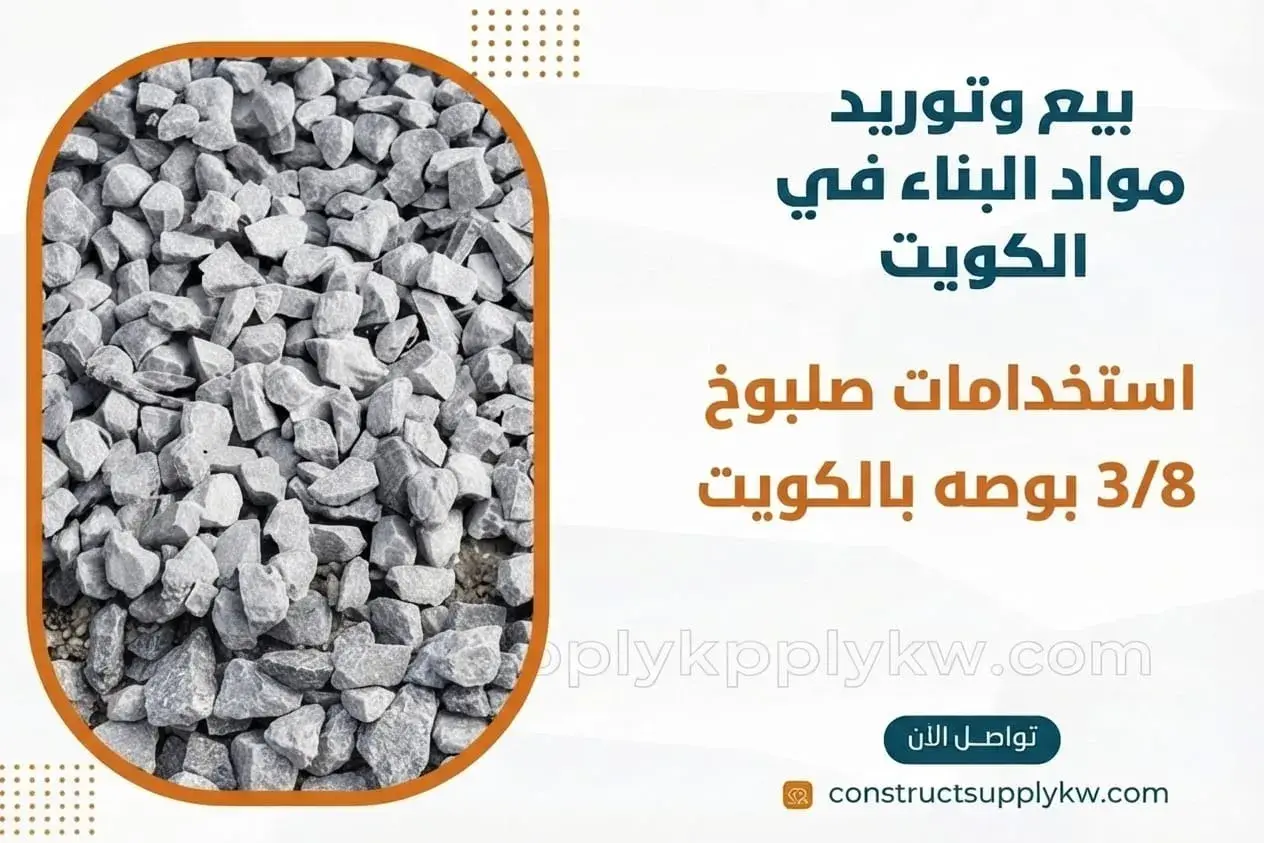
3/8-inch crushed aggregate is distinguished by its relatively small coarse aggregate size compared to 3/4-inch aggregate, allowing it to distribute more efficiently throughout concrete while reaching confined spaces between reinforcing bars without requiring additional mixing water or negatively affecting the concrete mix design. This aggregate has a nominal particle size of approximately 10 mm, making it particularly suitable for structural elements that require precise particle distribution and enhanced concrete density. Its smaller size should never be interpreted as lower structural strength because its performance depends entirely on the quality of the parent rock, laboratory test results, and full compliance with engineering specifications. Across many construction projects in Kuwait, engineers recommend 3/8-inch crushed aggregate for slabs, suspended ceilings, and relatively thin structural members where larger aggregate sizes could reduce compaction quality or increase the likelihood of honeycombing. This aggregate size also improves workability in modern concrete mixtures, especially when pumping concrete into congested reinforcement or intricate formwork. Practical field experience consistently demonstrates that the difference between a project producing smooth, uniform concrete surfaces and another suffering from visible defects is often determined not only by construction workmanship but also by selecting the appropriate aggregate size for each structural application. Engineers therefore regard 3/8-inch crushed aggregate as a specialized engineering solution rather than simply a smaller coarse aggregate.
-
It is ideal for structural elements with limited thickness.
-
It flows easily through densely reinforced concrete sections.
-
It helps reduce the risk of honeycombing.
-
It provides more uniform aggregate distribution throughout concrete.
-
It is suitable for projects requiring precise workmanship.
-
It performs well in modern concrete mix designs.
-
It is approved only after comprehensive quality testing.
-
It contributes to superior concrete surface appearance.
-
It performs efficiently in pumped concrete applications.
-
It is considered a specialized engineering solution for precision concrete work.
Crushed Aggregate for Ceilings
Crushed aggregate for ceilings plays a critical role in the successful construction of suspended slabs and reinforced concrete ceilings because these structural elements typically combine limited thickness with dense reinforcement arrangements. This combination requires aggregate capable of flowing easily throughout the concrete without creating voids or affecting uniform concrete distribution within the formwork. For this reason, many structural engineers specify 3/8-inch crushed aggregate when constructing suspended slabs, particularly in projects demanding premium concrete finishes or involving complex structural details. The smaller aggregate size improves concrete consolidation while reducing the need for excessive vibration that could otherwise lead to segregation if not performed correctly. It also contributes to smoother concrete surfaces after formwork removal, reducing corrective finishing work and improving construction efficiency during later finishing stages. Professional construction projects throughout Kuwait carefully coordinate aggregate selection among structural designers, site engineers, and ready-mix concrete suppliers to ensure compatibility between aggregate size, reinforcement density, mix design, and placement method. Practical experience has repeatedly shown that many honeycombing problems in concrete ceilings result not from poor concrete quality but from selecting aggregate that is too large for the slab thickness or reinforcement configuration. Consequently, choosing the proper crushed aggregate for ceilings is considered one of the essential engineering decisions contributing to successful reinforced concrete construction.
-
It improves concrete flow throughout suspended slabs.
-
It reduces void formation between reinforcing bars.
-
It enhances concrete consolidation efficiency.
-
It provides smoother finished concrete surfaces.
-
It minimizes the likelihood of honeycombing.
-
It is ideal for relatively thin concrete slabs.
-
It is compatible with modern concrete placement techniques.
-
It facilitates the construction of detailed structural elements.
-
It reduces repair work after formwork removal.
-
It significantly improves the overall quality of ceiling construction.
Crushed Aggregate for Slabs
.webp)
Crushed aggregate for slabs directly influences both the structural performance and construction quality of reinforced concrete floor systems because slabs require concrete that spreads easily while maintaining its specified compressive strength and internal uniformity. For this reason, 3/8-inch crushed aggregate is frequently selected for many slab applications, particularly where slab thickness is limited or where embedded utilities, service openings, and dense reinforcement reduce the available space between reinforcing bars. This aggregate size promotes highly uniform particle distribution throughout the slab, reducing the possibility of air pockets or weak zones that could later affect structural integrity. It also contributes to superior slab surface finishes while minimizing the need for corrective treatment after concrete placement. In projects relying on high-volume concrete pumping, 3/8-inch crushed aggregate provides better flow characteristics than larger aggregate sizes, allowing construction crews to complete placement more efficiently without compromising concrete quality. Field experience consistently confirms that selecting the proper aggregate size for slabs is an engineering decision just as important as specifying concrete strength or cement type because all these factors work together to achieve the intended structural performance.
-
It is suitable for reinforced concrete slabs of various thicknesses.
-
It promotes uniform aggregate distribution throughout slab sections.
-
It minimizes internal void formation.
-
It improves concrete flow during placement.
-
It contributes to superior slab surface finishing.
-
It enhances the quality of thin reinforced concrete elements.
-
It performs efficiently with concrete pumping systems.
-
It reduces the need for post-placement corrective work.
-
It supports consistent concrete quality.
-
It represents one of the best aggregate choices for slabs requiring detailed structural execution.
Fine Aggregate for Concrete
When discussing fine aggregate for concrete, it is important to distinguish between the formal engineering definition and the terminology commonly used on construction sites. According to engineering standards, sand is classified as fine aggregate, while 3/8-inch crushed aggregate remains a small-sized coarse aggregate. However, many contractors and construction professionals informally describe it as "fine aggregate" when comparing it with larger sizes such as 3/4-inch and 1-inch crushed stone because of its relatively small particle dimensions and its ability to distribute more efficiently throughout concrete. Understanding this distinction helps prevent confusion during material procurement and concrete mix design. This aggregate size enhances internal particle distribution within structural elements that contain narrow spaces, allowing higher concrete density without unnecessarily increasing cement paste content. The smaller particles also reduce the possibility of air voids surrounding reinforcing steel, thereby improving hardened concrete quality. In Kuwaiti construction projects requiring precision finishes or relatively thin concrete slabs, many engineers prefer this aggregate size because it promotes more uniform particle distribution throughout the mix. Nevertheless, it is not intended to replace all other aggregate sizes. Instead, it is incorporated within a carefully engineered mix design that balances different aggregate gradations to achieve optimum density and performance. Consequently, successful concrete production depends not simply on smaller aggregate size but on achieving proper integration among all concrete constituents to deliver the required structural performance without excessive cement consumption or unnecessary cost.
-
It promotes more uniform aggregate distribution within detailed structural elements.
-
It improves concrete density in specialized applications.
-
It reduces air voids around reinforcing steel.
-
It contributes to smoother finished concrete surfaces.
-
It improves concrete workability during placement.
-
It is incorporated according to engineered mix designs.
-
It is well suited for architecturally detailed structural elements.
-
It works effectively alongside other aggregate sizes.
-
It contributes to stable long-term concrete quality.
-
It is selected according to specific project requirements.
Aggregate Size for Ceilings
.webp)
Aggregate size for ceilings is one of the engineering decisions that has a greater impact on construction quality than many construction professionals initially realize because suspended slabs combine reinforcement congestion, limited thickness, and demanding finishing requirements within a single structural element. Engineers therefore do not automatically choose the largest aggregate size available. Instead, they select the aggregate that allows concrete to flow freely through reinforcement while maintaining the required structural performance. In many suspended slabs and reinforced concrete ceilings, 3/8-inch crushed aggregate successfully achieves this objective because its smaller particle size minimizes the possibility of aggregate becoming trapped between reinforcing bars or creating inaccessible voids after concrete placement. Selecting the proper aggregate size also improves construction productivity by enhancing pumping efficiency and reducing the need for excessive vibration that could otherwise cause concrete segregation. Experience from numerous projects throughout Kuwait shows that selecting the correct aggregate size during mix design substantially reduces repair work following formwork removal while improving concrete surface quality without requiring additional finishing treatments. Consequently, aggregate size selection for ceilings is never based on contractor preference alone but on careful engineering evaluation of slab thickness, reinforcement density, concrete properties, and construction methods.
-
It is selected according to slab thickness and reinforcement density.
-
It directly influences concrete flow within suspended slabs.
-
It helps minimize honeycombing.
-
It improves pumping and consolidation efficiency.
-
It reduces repair work after concrete placement.
-
It enhances finished concrete surface quality.
-
It forms part of the engineered concrete mix design.
-
It supports modern construction practices.
-
It contributes to stable concrete performance.
-
It is an essential factor in successful ceiling construction.
Concrete for Slabs
Concrete for slabs is one of the most demanding types of structural concrete because slabs are not only responsible for carrying structural loads but also serve as the primary surface for waterproofing systems, flooring materials, ceramic tiles, stone finishes, and many other architectural applications. Consequently, any lack of concrete uniformity or poor aggregate distribution can later appear as honeycombing, cracking, uneven surfaces, or localized weak areas. Using 3/8-inch crushed aggregate in many slab applications provides a significant advantage by improving aggregate distribution throughout the concrete section, particularly where embedded services, openings, or congested reinforcement reduce the available space within the slab. This aggregate size also improves concrete flow during placement without requiring additional mixing water or compromising the specified compressive strength when the mix is properly designed. In professional construction projects, engineers do not view this aggregate size merely as a way to improve finishing quality. Instead, they recognize it as an important contributor to the structural integrity of the slab from the moment concrete is placed until the structure reaches the end of its design service life. For this reason, selecting the appropriate aggregate for slab construction should always involve coordination between the structural engineer, the ready-mix concrete supplier, and the site execution team to ensure the concrete mix satisfies both structural and construction requirements.
-
It promotes uniform aggregate distribution throughout reinforced slabs.
-
It improves concrete placement and finishing quality.
-
It reduces the likelihood of honeycombing.
-
It is suitable for slabs containing complex structural details.
-
It provides better pumping performance during placement.
-
It helps concrete achieve its specified design strength.
-
It supports the quality of subsequent finishing work.
-
It minimizes surface defects after formwork removal.
-
It complies with the requirements of modern construction projects.
-
It provides more stable long-term slab performance.
Concrete Finishing

Concrete finishing represents the stage where every decision made during concrete mix design, material selection, and placement becomes visible. The quality of the finished concrete surface depends not only on construction workmanship but also on selecting the appropriate aggregate size before concrete placement begins. When 3/8-inch crushed aggregate is used in structural elements requiring precision, aggregate particles distribute more uniformly throughout the concrete, significantly reducing surface voids, honeycombing, and irregular textures after formwork removal. This smaller aggregate size also produces smoother concrete surfaces that require less corrective work before waterproofing, flooring systems, architectural coatings, or decorative finishes are installed. In projects featuring exposed architectural concrete, engineers place particular emphasis on aggregate quality because inconsistent particle distribution immediately affects the visual appearance of the completed structure. Field experience from construction projects throughout Kuwait demonstrates that selecting appropriate aggregate, combined with proper consolidation and curing, substantially reduces the number of surface defects requiring repair after stripping formwork. This saves both construction time and maintenance costs while improving overall project quality. Consequently, concrete finishing should never be viewed as an isolated construction activity but rather as the direct outcome of selecting high-quality materials and implementing sound engineering practices throughout every stage of concrete construction.
-
It produces smoother and more uniform concrete surfaces.
-
It minimizes surface honeycombing and visible voids.
-
It reduces repair work following formwork removal.
-
It prepares concrete for waterproofing and architectural finishes.
-
It improves the overall appearance of structural concrete.
-
It supports exposed concrete architectural applications.
-
It minimizes surface inconsistencies across placement areas.
-
It enhances the performance of flooring and finishing systems.
-
It contributes significantly to construction quality.
-
It begins with selecting the appropriate aggregate before placement.
Crushed Aggregate for Precision Construction
Crushed aggregate for precision construction is widely used in reinforced concrete elements requiring exceptional execution accuracy, including narrow beams, concrete staircases, edge beams, thin structural members, slabs containing numerous service penetrations, and specialized architectural components that are difficult to construct using larger aggregate sizes. The primary advantage of 3/8-inch crushed aggregate is its ability to flow easily throughout confined formwork, even where reinforcement spacing is extremely limited. This significantly reduces the likelihood of aggregate particles becoming trapped between reinforcing bars, thereby improving concrete consolidation and minimizing visible defects after formwork removal. In projects with demanding engineering specifications, designers frequently specify this aggregate size whenever the objective is to achieve maximum construction quality without sacrificing the required structural strength of the concrete. Practical construction experience consistently demonstrates that selecting the correct aggregate size for precision concrete work substantially reduces repair time because superior quality is achieved during the initial concrete placement rather than through corrective measures afterward. Consequently, 3/8-inch crushed aggregate should not be regarded as merely an alternative aggregate size but as a specialized construction material specifically developed for structural and architectural applications requiring exceptional precision.
-
It is ideal for relatively small reinforced concrete elements.
-
It allows concrete placement in narrow and congested spaces.
-
It minimizes aggregate blockage between reinforcing bars.
-
It improves the quality of detailed architectural concrete.
-
It performs efficiently in staircases and edge beam construction.
-
It reduces repair work following concrete placement.
-
It supports accurate formwork execution.
-
It produces greater concrete uniformity in precision applications.
-
It is specified for projects requiring premium workmanship.
-
It is particularly effective in structurally complex concrete elements.
Aggregate Distribution
.webp)
Aggregate distribution throughout concrete is one of the most important factors influencing the quality of hardened concrete because success depends not simply on including sufficient aggregate but on ensuring that particles are dispersed uniformly throughout the entire structural section without concentrating in one area or separating from the cement paste. 3/8-inch crushed aggregate significantly improves this distribution, particularly within slabs, suspended ceilings, and heavily reinforced structural members where smaller particles move more efficiently through the concrete during pumping and consolidation, filling confined spaces with greater effectiveness. Uniform aggregate distribution minimizes weak zones within structural elements, thereby improving compressive strength, finishing quality, and long-term structural durability. Professional construction projects never rely solely on aggregate type. Instead, engineers carefully optimize aggregate proportions within the mix design to maximize concrete density while minimizing internal voids. Practical field experience consistently demonstrates that concrete exhibiting uniform aggregate distribution achieves superior laboratory test results while experiencing fewer shrinkage-related cracks and localized structural imperfections than concrete produced with poorly graded aggregate distribution.
-
It promotes highly uniform concrete structure.
-
It minimizes internal void formation.
-
It improves long-term concrete strength.
-
It reduces aggregate segregation.
-
It enhances finished concrete quality.
-
It increases consolidation efficiency within formwork.
-
It contributes to stable concrete performance.
-
It minimizes shrinkage-related cracking.
-
It depends on a properly engineered concrete mix.
-
It represents a fundamental requirement for high-quality structural concrete.
3/8-Inch Aggregate Specifications
3/8-inch aggregate specifications provide the engineering foundation for approving this material in construction projects because particle size alone cannot guarantee successful concrete performance or construction quality. The aggregate must be produced from durable rock possessing high crushing resistance, abrasion resistance, and long-term mechanical stability. It must also satisfy laboratory requirements for particle size distribution, density, water absorption, and cleanliness while remaining free from clay, organic matter, soluble salts, and other contaminants capable of reducing concrete strength or durability. Production consistency is equally important because every shipment should demonstrate nearly identical physical and mechanical properties to ensure consistent concrete performance throughout the project. Across Kuwait, consulting engineers rely on accredited laboratory testing before approving any aggregate source and continue performing routine quality verification during construction to confirm that aggregate quality remains unchanged. When these engineering requirements are fully satisfied, 3/8-inch crushed aggregate becomes an outstanding choice for slabs, suspended ceilings, and precision concrete work because it combines excellent workability, superior finishing quality, and dependable structural performance. Selecting a supplier committed to recognized engineering standards is therefore just as important as choosing the appropriate cement type or designing the correct concrete mix.
-
It must fully comply with recognized engineering specifications.
-
It must exhibit excellent crushing and abrasion resistance.
-
It must satisfy grading, density, and absorption requirements.
-
It must remain free from harmful contaminants.
-
It must maintain consistent quality across all production batches.
-
It should be verified through accredited laboratory testing.
-
It is particularly suitable for slabs and precision concrete applications.
-
It supports stable, high-quality concrete production.
-
It improves both structural and finishing performance.
-
It represents one of the primary quality requirements for successful concrete construction.
Conclusion
3/8-inch crushed aggregate is a specialized engineering solution whenever construction projects require superior aggregate distribution, improved concrete finishing, and exceptional execution quality in thin or heavily reinforced structural elements. Throughout this article, we examined the characteristics of 3/8-inch crushed aggregate, its applications in ceilings and slabs, its relationship to aggregate distribution, its influence on concrete finishing, its role in precision construction work, and the engineering specifications required to ensure dependable structural performance. When high-quality aggregate complying with engineering standards is incorporated into a properly designed concrete mix, contractors can produce concrete that combines strength, durability, excellent workability, and outstanding finishing quality while minimizing construction defects and improving project performance from the first concrete placement through the completion of finishing works.
Frequently Asked Questions
What is 3/8-inch crushed aggregate?
It is a small-sized coarse aggregate with a nominal particle size of approximately 10 mm that is commonly used in ceilings, slabs, and reinforced concrete elements requiring precise aggregate distribution.
Why is 3/8-inch crushed aggregate used in ceilings?
Because it flows easily between reinforcing bars, reduces the risk of honeycombing, and improves both concrete placement quality and final surface finishing.
Is 3/8-inch crushed aggregate suitable for every type of concrete?
No. Its use depends on the structural element, concrete mix design, reinforcement arrangement, and specific engineering requirements of each project.
Does aggregate size affect concrete finishing quality?
Yes. Selecting the proper aggregate size contributes to smoother concrete surfaces and significantly reduces repair work after concrete placement.
What are the most important specifications for 3/8-inch crushed aggregate?
It should comply with engineering standards, possess high crushing resistance, remain free from contaminants, and maintain consistent grading and production quality.
Is 3/8-inch crushed aggregate used only for slabs?
No. It is also widely used in staircases, edge beams, precision structural elements, architectural concrete, and other applications requiring detailed construction.
How can the quality of 3/8-inch crushed aggregate be verified?
Its quality is confirmed through accredited laboratory testing, supplier approval, grading analysis, density measurements, crushing resistance evaluation, and cleanliness inspections before use in construction.

.webp)
.webp)