3/4-inch crushed aggregate is one of the most widely used types of coarse aggregate in modern construction projects, not simply because it is a common size, but because it provides the ideal engineering balance between concrete strength and workability during construction. Selecting aggregate size is never a random decision. Instead, it depends on the type of structural element, reinforcement density, expected loads, and concrete mix design requirements. For this reason, concrete manufacturers and consulting engineering firms in Kuwait rely on crushed aggregate that fully complies with technical specifications and undergoes comprehensive quality testing before being approved for use on any project. This type of aggregate directly influences compressive strength, minimizes internal voids, improves concrete durability, and extends the service life of structures. Understanding its characteristics, applications, and selection criteria enables engineers, contractors, and project owners to make informed decisions from the beginning of construction while avoiding many problems that could appear later during the building's operational life.
3/4-Inch Crushed Aggregate
.webp)
3/4-inch crushed aggregate forms the backbone of most concrete mixes used in residential, commercial, and industrial construction because it provides the ideal balance between particle size and the ability to distribute uniformly throughout the concrete mixture without compromising placement or compaction efficiency. This aggregate has a nominal size of approximately 19 mm, making it one of the standard sizes adopted by most international and Gulf engineering specifications for foundations, slabs, columns, beams, and a wide range of reinforced concrete elements. Its importance extends beyond its dimensions, as it creates the internal structural framework of concrete. The aggregate particles distribute loads efficiently, reduce shrinkage, and improve compressive strength once the concrete hardens. For this reason, ready-mix concrete plants throughout Kuwait depend on crushed aggregate produced by reputable quarries that perform continuous quality control testing on every production batch to ensure consistent performance. The aggregate is also carefully inspected to ensure it is free from dust, clay, and weak particles that could prevent proper bonding between the cement paste and the aggregate surface. Any contamination can significantly reduce concrete strength, even when premium cement and reinforcing steel are used. Practical construction experience has repeatedly demonstrated that many cases of low concrete cube test results were caused not by incorrect cement content or water ratio, but by poor-quality coarse aggregate that failed to meet engineering specifications. Therefore, engineers do not treat 3/4-inch crushed aggregate as a secondary material within the mix. Instead, they recognize it as the largest component of concrete by volume and one of the primary factors determining load-bearing capacity, durability, and long-term structural performance.
-
It is used in the majority of structural concrete mix designs.
-
It provides an ideal balance between particle size and workability.
-
It contributes significantly to higher compressive strength.
-
It minimizes the formation of internal voids within concrete.
-
It is suitable for foundations, columns, slabs, and beams.
-
It is widely used by high-quality ready-mix concrete plants.
-
It must be free from clay, dust, and weak particles.
-
It undergoes continuous laboratory quality testing.
-
It contributes to extending the service life of concrete structures.
-
It is one of the most commonly specified aggregate sizes in Kuwait's construction industry.
Coarse Aggregate for Concrete
Coarse aggregate for concrete is the component that carries the majority of structural loads after concrete has hardened because it occupies more than half of the total concrete volume in many mix designs. Consequently, aggregate quality is just as important as cement quality and reinforcing steel quality. Any weakness in aggregate properties directly affects concrete performance, regardless of how well the remaining materials comply with specifications. High-quality coarse aggregate must exhibit excellent crushing resistance, abrasion resistance, low water absorption, and freedom from internal fractures, weak particles, harmful salts, and contaminants that could reduce long-term durability. The texture of aggregate particles also plays a critical role in the bond between aggregate and cement paste. Properly textured particles achieve stronger mechanical interlock than excessively smooth particles. Major construction projects in Kuwait approve only specific aggregate sources after laboratory testing confirms crushing resistance, absorption rate, density, and grading compliance. These procedures ensure concrete reaches its specified design strength without unnecessary increases in cement consumption or frequent modifications to the mix design. Practical experience consistently shows that premium coarse aggregate directly improves compressive strength test results and enables concrete to withstand harsh environmental conditions and extreme temperatures commonly experienced throughout the Gulf region. Therefore, selecting coarse aggregate is considered one of the first engineering decisions made before finalizing the concrete mix because it largely determines the expected performance and durability of the completed structure throughout its service life.
-
It represents the largest proportion of reinforced concrete.
-
It carries a significant share of structural loads.
-
It must possess high crushing and abrasion resistance.
-
It improves the long-term durability of concrete.
-
It minimizes the need for continuous mix adjustments.
-
It is approved only after comprehensive laboratory testing.
-
It directly influences compressive strength results.
-
It enhances concrete performance under severe environmental conditions.
-
It contributes to stable long-term structural behavior.
-
It forms the foundation of high-quality concrete mix design.
3/4 Aggregate Size
The 3/4 aggregate size is one of the most widely specified dimensions in concrete mix design because it satisfies the requirements of most structural elements without requiring significant adjustments to aggregate proportions or mix composition. This size allows concrete to flow efficiently between reinforcing bars, even in heavily reinforced members, ensuring that every section of the formwork is filled without creating honeycombing or internal voids after placement. Its uniform particle distribution also reduces aggregate segregation during transportation and pumping, leading to higher-quality finished concrete and fewer visible surface defects after formwork removal. Quality control engineers carefully verify that aggregate particles remain within specification limits through sieve analysis because excessive oversized or undersized material can affect concrete density, cement demand, and workability. Professional construction projects throughout Kuwait rely on this aggregate size for foundations, slabs, beams, and columns because it offers the ideal balance between structural performance and construction efficiency while remaining fully compatible with modern ready-mix plants and concrete pumping systems. Field experience consistently demonstrates that selecting the correct aggregate size significantly reduces construction defects and provides more reliable quality test results compared to non-uniform aggregate sources.
-
Its nominal size is approximately 19 mm.
-
It is suitable for most reinforced concrete elements.
-
It allows concrete to flow easily through reinforcement.
-
It minimizes honeycombing after placement.
-
It improves pumping and transportation efficiency.
-
It is verified through sieve grading analysis.
-
It supports stable concrete mix performance.
-
It balances workability and structural strength.
-
It is extensively used in ready-mix concrete production.
-
It remains the standard aggregate size for many structural projects.
Crushed Aggregate for Concrete Foundations
Crushed aggregate for concrete foundations is one of the most critical materials used in structural construction because foundations are responsible for transferring the building's loads safely into the supporting soil. Any weakness in the quality of coarse aggregate directly affects the concrete's ability to withstand these loads throughout the structure's service life. Selecting aggregate for foundations is therefore based on much more than particle size. Engineers evaluate crushing resistance, water absorption, particle durability, cleanliness, and compatibility with the concrete mix design before approving any material for use. When high-quality 3/4-inch crushed aggregate is incorporated into foundation concrete, the resulting mix becomes denser, stronger, and more resistant to internal void formation that could otherwise reduce compressive strength or allow moisture to penetrate reinforcing steel. On major construction projects throughout Kuwait, aggregate is approved only after laboratory reports confirm full compliance with project specifications, and every new shipment is inspected to verify consistency with previous deliveries. Quality control engineers also monitor aggregate during batching and placement to prevent contamination with unsuitable materials that could compromise concrete performance. Practical field experience consistently demonstrates that many foundation-related performance issues originate not from foundation design itself, but from poor-quality construction materials. For this reason, selecting premium crushed aggregate for concrete foundations should be viewed as an investment in the long-term safety, stability, and durability of the entire structure rather than simply another construction material purchase.
-
It significantly improves the load-bearing capacity of concrete foundations.
-
It increases concrete density while reducing internal voids.
-
It helps prevent moisture from reaching reinforcing steel.
-
It is approved only after comprehensive laboratory testing.
-
It is fully compatible with structural foundation concrete designs.
-
It contributes to long-term compressive strength performance.
-
It undergoes continuous quality control on major projects.
-
It reduces the risk of construction defects within foundations.
-
It enhances the structural stability of buildings from the ground up.
-
It is considered one of the most important components in foundation concrete.
Crushed Aggregate for Roads
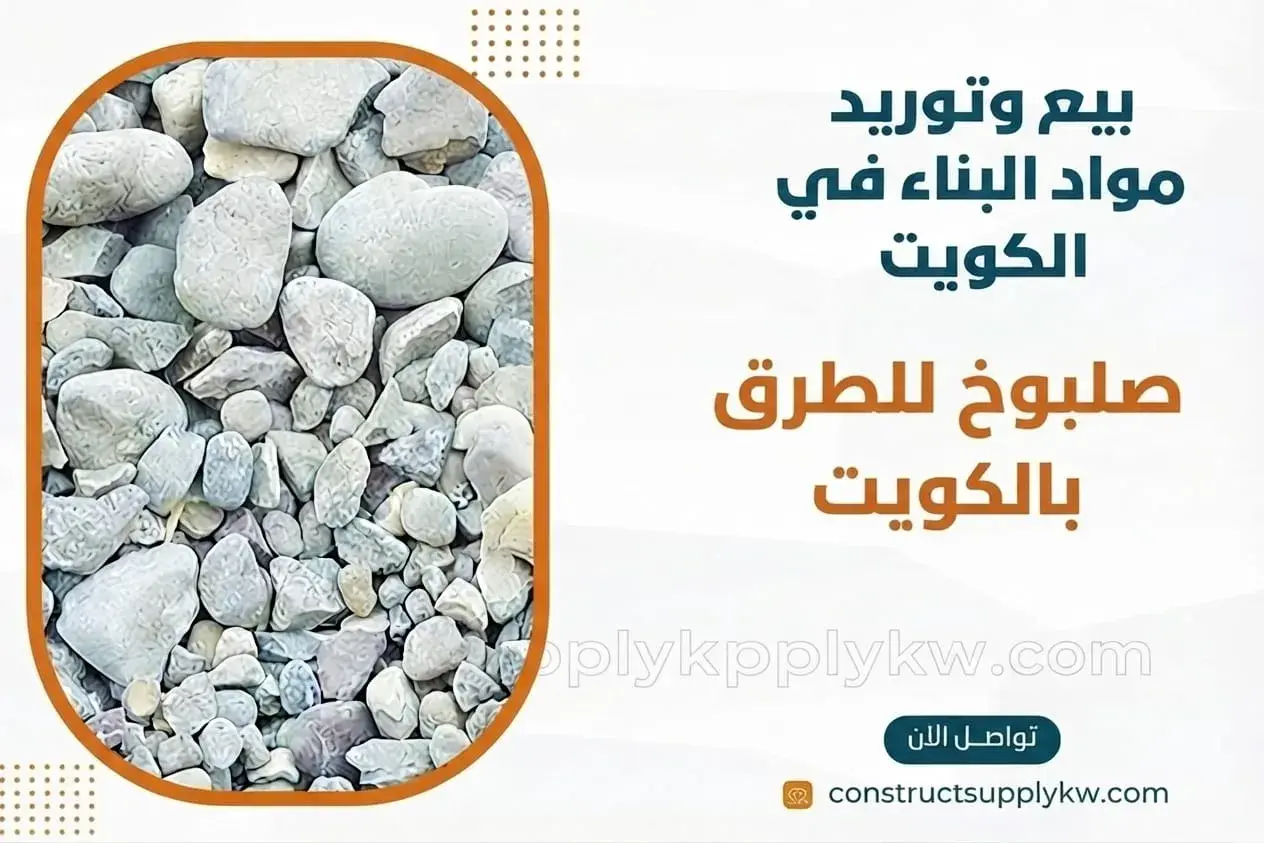
Crushed aggregate for roads is extensively used in highways, parking areas, industrial yards, and infrastructure projects, although its engineering requirements differ considerably from those of reinforced concrete applications. In road construction, engineers focus not only on compressive strength but also on the aggregate's resistance to abrasion, impact, polishing, and repeated traffic loading over many years of service. Therefore, aggregate selection is based on characteristics such as hardness, durability, resistance to fragmentation, dimensional stability, and weather resistance, in addition to compatibility with the specific pavement layer where it will be installed. Throughout Kuwait, road construction projects rely on aggregate supplied by approved quarries that conduct continuous quality testing to maintain consistent production standards because poor aggregate quality can lead to premature cracking, rutting, settlement, and rapid pavement deterioration. Depending on pavement design, 3/4-inch crushed aggregate may be incorporated into asphalt mixtures, concrete pavement, or selected structural base applications where its mechanical properties provide optimum performance. Field experience has repeatedly shown that aggregate quality remains one of the strongest factors influencing pavement lifespan, making laboratory performance results and supplier reliability far more important than selecting the lowest-priced material. Investing in high-quality aggregate during construction greatly reduces maintenance requirements and extends the operational life of transportation infrastructure.
-
It is widely used in highways and infrastructure projects.
-
It withstands repeated vehicle loading effectively.
-
It offers excellent resistance to abrasion and wear.
-
It undergoes extensive quality testing before approval.
-
It serves different pavement layers according to design requirements.
-
It helps maximize pavement service life.
-
It minimizes settlement and early cracking.
-
It is supplied by certified aggregate producers.
-
It complies with modern road construction standards.
-
It plays a major role in pavement quality and durability.
Aggregate Strength
Aggregate strength is one of the most important engineering indicators used to determine whether crushed aggregate is suitable for concrete or road construction because it reflects the ability of individual particles to withstand applied loads without crushing or disintegrating during mixing, transportation, placement, or long-term service. The stronger the aggregate, the better the concrete maintains its mechanical properties throughout its operational life, especially in structures subjected to heavy loads or severe environmental conditions. Aggregate strength cannot be judged simply by visual appearance because some stones appear solid externally while containing hidden internal fractures that only laboratory testing can identify. Consequently, engineering laboratories perform standardized mechanical tests to evaluate aggregate strength before approving materials for construction projects. The geological origin of the rock also significantly affects strength characteristics, meaning aggregate from different quarries may perform very differently even when particle size remains identical. Experience from numerous construction projects in Kuwait demonstrates that high-strength aggregate substantially reduces the likelihood of concrete strength deficiencies and premature pavement deterioration, making aggregate strength one of the primary selection criteria used by consulting engineers rather than merely another laboratory test included within quality assurance procedures.
-
It measures the aggregate's ability to resist structural loads.
-
It directly affects the durability of concrete and pavements.
-
It varies according to rock type and quarry source.
-
It is determined through standardized laboratory testing.
-
It helps engineers select the most suitable supplier.
-
It minimizes particle breakdown during construction.
-
It preserves concrete performance over time.
-
It contributes to longer structural service life.
-
It represents a key approval criterion for construction materials.
-
It has a direct impact on overall project quality.
Aggregate Crushing Test
.webp)
The aggregate crushing test is one of the most important laboratory procedures performed before coarse aggregate is approved for structural construction because it evaluates the ability of aggregate particles to resist compressive forces without excessive crushing or disintegration. This test is not performed merely to satisfy quality documentation requirements. Instead, it provides engineers with measurable evidence that the aggregate can withstand the stresses expected in reinforced concrete structures and road construction projects. The test procedure involves placing a carefully prepared aggregate sample inside a standardized testing cylinder, applying a gradually increasing compressive load through a calibrated testing machine, and then determining the percentage of crushed material produced under the specified loading conditions. Lower crushing values indicate stronger aggregate with greater resistance to mechanical stresses, making it more suitable for demanding structural applications. On major construction projects in Kuwait, consultants often require independent laboratory verification rather than relying solely on supplier certificates, ensuring that every shipment meets project specifications before it is incorporated into the work. The test is also repeated whenever the aggregate source changes or when visual inspection suggests differences in particle characteristics. Practical construction experience has demonstrated that many cases of reduced concrete strength and premature pavement deterioration were directly linked to aggregates that failed crushing resistance requirements. As a result, the aggregate crushing test has become one of the primary acceptance criteria used in modern construction quality management systems because it provides confidence that the aggregate will maintain its structural integrity throughout the service life of the completed project.
-
It measures the aggregate's resistance to compressive loading.
-
It determines the percentage of particle crushing under controlled conditions.
-
It is performed before aggregate approval for construction projects.
-
It provides objective data for evaluating supplier quality.
-
It is conducted in certified engineering laboratories.
-
It identifies internal weaknesses that cannot be detected visually.
-
It improves confidence in concrete and pavement performance.
-
It is repeated whenever aggregate sources change.
-
It forms a key part of construction quality assurance programs.
-
It helps engineers select durable aggregate for long-term structural performance.
Coarse Aggregate Specifications
Coarse aggregate specifications establish the engineering standards that determine whether crushed aggregate is suitable for reinforced concrete or road construction because aggregate quality cannot be judged by appearance or particle size alone. Instead, it must satisfy a comprehensive set of physical, mechanical, and chemical requirements that ensure reliable long-term performance. These specifications typically include crushing resistance, particle size distribution, density, water absorption, abrasion resistance, durability, cleanliness, and freedom from harmful materials such as clay, organic matter, soluble salts, and other contaminants that could weaken concrete or reduce its durability. Engineering specifications also require aggregate particles to possess sufficient hardness and structural integrity so they maintain their properties under repeated loading and varying environmental conditions. Throughout professional construction projects in Kuwait, consulting engineers rely on laboratory reports rather than commercial product descriptions when approving aggregate sources. Every shipment is verified through periodic testing to confirm that production quality remains consistent throughout the project's duration. Practical experience has shown that strict compliance with coarse aggregate specifications from the earliest stages of construction significantly reduces the likelihood of structural defects, costly repairs, and premature deterioration because aggregate quality directly influences the overall performance and service life of reinforced concrete structures.
-
They define the engineering requirements for aggregate approval.
-
They include crushing resistance, grading, density, and water absorption.
-
They require aggregate to be free from harmful contaminants.
-
They ensure long-term concrete durability and performance.
-
They rely on certified laboratory testing for verification.
-
They apply to both building and infrastructure projects.
-
They help engineers select reliable aggregate suppliers.
-
They reduce the likelihood of construction defects.
-
They require continuous quality verification during production.
-
They provide the technical foundation for high-quality structural concrete.
Washed Crushed Aggregate

Washed crushed aggregate is considered the preferred choice for many reinforced concrete applications because the washing process is designed to remove dust, clay, salts, and fine particles that could interfere with the bond between cement paste and aggregate surfaces. The objective is not simply to improve the appearance of the aggregate but to produce cleaner, more consistent material capable of delivering higher-quality concrete. Clean aggregate allows cement paste to adhere more effectively to individual particles, resulting in improved compressive strength, better internal cohesion, and reduced segregation during mixing, transportation, and placement. For this reason, ready-mix concrete plants across Kuwait frequently specify washed aggregate for projects requiring high levels of quality, including high-rise buildings, industrial facilities, government projects, and heavily supervised structural works. Another important advantage is that washed aggregate minimizes variability in water demand because dust and ultra-fine particles no longer absorb unnecessary mixing water or alter the designed water-cement ratio. Field experience consistently demonstrates that concrete produced with washed aggregate achieves more stable compressive strength results and exhibits fewer problems such as honeycombing, weak bonding, and surface imperfections. Rather than representing an additional project expense, washed crushed aggregate should be viewed as an investment in construction quality, structural durability, and reduced maintenance throughout the building's operational life.
-
It is free from dust, clay, and harmful fine particles.
-
It improves the bond between cement paste and aggregate.
-
It contributes to higher concrete compressive strength.
-
It reduces the risk of aggregate segregation.
-
It provides more consistent concrete quality.
-
It is widely used in projects requiring strict quality standards.
-
It minimizes the effects of contaminants on concrete performance.
-
It is preferred by modern ready-mix concrete producers.
-
It improves the quality of finished structural elements.
-
It represents the preferred aggregate choice for professional construction projects.
Best Aggregate for Concrete
Determining the best aggregate for concrete cannot be based solely on supplier reputation or purchase price because the correct selection depends on engineering specifications, project requirements, and the intended structural application. Aggregate that performs well in a residential building may not necessarily be appropriate for industrial facilities, bridges, or infrastructure projects subjected to significantly higher design loads. Engineers therefore evaluate aggregate using a comprehensive range of performance criteria, including crushing resistance, particle size distribution, density, water absorption, cleanliness, durability, and production consistency from one delivery to the next. Reliable suppliers are expected to provide regular laboratory reports confirming compliance with recognized engineering standards while maintaining stable production quality over time. Consistency is particularly important because variations between aggregate shipments can require changes to concrete mix designs and may affect compressive strength test results. Throughout Kuwait, major construction projects typically establish long-term agreements with approved quarries and aggregate producers known for dependable quality control and uninterrupted supply. Practical construction experience has repeatedly shown that the best aggregate is rarely the least expensive option. Instead, it is the material that consistently satisfies engineering requirements, achieves reliable laboratory performance, supports high-quality concrete production, minimizes construction risks, and provides the durability necessary for structures expected to perform safely for decades.
-
It fully complies with recognized engineering specifications.
-
It provides excellent crushing and abrasion resistance.
-
It offers well-controlled particle size distribution.
-
It has low water absorption and minimal impurities.
-
It maintains consistent quality across all production batches.
-
It is supplied by producers with proven quality control systems.
-
It supports the achievement of design compressive strength.
-
It minimizes the need for concrete mix adjustments.
-
It extends the service life of reinforced concrete structures.
-
It represents the most reliable choice for professional construction projects.
Conclusion
3/4-inch crushed aggregate remains one of the most important components of modern structural concrete because it combines the ideal particle size, high mechanical strength, and excellent compatibility with reinforced concrete and infrastructure applications. Throughout this article, we examined the characteristics of 3/4-inch crushed aggregate, the importance of coarse aggregate in concrete production, the engineering significance of this aggregate size, its applications in concrete foundations and road construction, the role of aggregate strength, the importance of the aggregate crushing test, the engineering specifications governing coarse aggregate, the advantages of washed crushed aggregate, and the criteria used to identify the best aggregate for concrete. When contractors and engineers select aggregate that fully complies with engineering specifications and verify its quality through continuous laboratory testing, they can produce stronger, more durable concrete capable of delivering reliable structural performance while minimizing future maintenance and repair costs over the entire service life of the project.
Frequently Asked Questions
What is 3/4-inch crushed aggregate?
It is a coarse aggregate with a nominal particle size of approximately 19 mm that is widely used in reinforced concrete, road construction, and infrastructure projects.
Why is 3/4-inch crushed aggregate commonly used in concrete?
Because it provides an excellent balance between structural strength, workability, and efficient concrete compaction while being suitable for most reinforced concrete elements.
Can 3/4-inch crushed aggregate be used in road construction?
Yes. It is widely used in various road construction applications depending on pavement design requirements and engineering specifications.
Why is the aggregate crushing test important?
The test evaluates the aggregate's ability to withstand compressive forces and determines whether it is suitable for use in structural concrete and pavement construction.
What is the difference between washed and unwashed crushed aggregate?
Washed crushed aggregate has dust, clay, salts, and other impurities removed before use, resulting in stronger bonding with cement paste and improved concrete performance.
How do engineers select the best aggregate for concrete?
Selection is based on laboratory testing, crushing resistance, particle size distribution, density, water absorption, cleanliness, durability, and compliance with engineering specifications.
Does the source of crushed aggregate affect concrete quality?
Yes. Aggregate properties vary according to the geological source and production process, which is why professional construction projects approve only qualified suppliers with consistent quality control.
Should crushed aggregate be tested regularly during construction?
Yes. Periodic laboratory testing of delivered aggregate is recommended throughout construction to verify consistent quality and continuous compliance with project specifications.
.webp)
.webp)